缺指(趾)-外胚层发育不良-唇腭裂综合征
(Ectrodactyly-Ectodermal Dysplasia-Clefting 䔀䔀䌀 Syndrome) 皮肤与外胚层发育不良 OMIM: OMIM 604292 全本详注版| 致病基因 / 机制 | 染色体定位 | 遗传方式 | 发病率估计 |
|---|---|---|---|
| TP63 | 3q27 | 常染色体显性遗传 | 尚无确切发病率数据;文献已报道超过200例 |
疾病概述与分子发病机理 (Genetics & Basic Defects)
流行病学数据、致病突变位点、信号转导通路及组织病理生理学
流行病学与全篇概述
EEC综合征(缺指(趾)-外胚层发育不良-唇腭裂综合征)是一种以外胚层发育不良、缺指(趾)畸形及唇裂/腭裂为核心表现的遗传性综合征。该病由TP63基因(位于3q27)的杂合性错义突变所致,呈常染色体显性遗传,约50%为家族性病例,另50%为散发性病例。家族性病例外显率不完全(93%–98%),临床表达高度可变,同一家系内及家系间均可存在显著表型差异;散发病例的表型通常较家族性病例更为严重。该综合征是TP63基因相关外胚层发育不良疾病谱中的原型,文献报道病例已超过200例。EEC综合征的发病机制涉及细胞凋亡调控异常:并指(趾)畸形源于指(趾)间细胞死亡失败;泌尿生殖系统异常源于沃尔夫管(Wolffian duct)或苗勒管(Mullerian duct)退化异常;面裂则归因于原始板(archetypal plate)融合过程中多余细胞清除异常。
遗传模式与家系特征
常染色体显性遗传。约50%为家族性病例,呈常染色体显性遗传,外显率不完全(93%–98%),临床表达高度可变;约50%为散发性病例,表型通常较家族性病例更严重。患者同胞的再发风险取决于父母状态:若父母一方患病,再发风险为50%;若父母双方均正常,再发风险不增加。患者子代的再发风险为50%。由于临床表达高度可变,遗传咨询存在困境;需考虑性腺嵌合(gonadal mosaicism)导致的不完全外显可能性。
致病基因与突变谱系
致病基因TP63位于染色体3q27。已鉴定至少三个EEC相关位点:EEC1(7q11.2-q21.3)、EEC2(19号染色体着丝粒周围区域)、EEC3(3q27)。EEC综合征的致病突变仅见于p63基因,为位于3q27的p63基因DNA结合结构域(DNA-binding domain)的杂合性突变。截至2010年,已报道34种TP63突变,大多数为TP63 DNA结合结构域(该区域对与DNA靶序列直接相互作用至关重要)的杂合性错义突变。基因型-表型相关性:EEC综合征、肢体-乳腺综合征(limb-mammary syndrome)及孤立性裂手/裂足畸形(split hand/split foot malformation)的p63突变存在基因型-表型相关性;EEC综合征中存在特定模式的错义突变,而这些突变通常不见于裂手/裂足畸形或肢体-乳腺综合征。EEC综合征是TP63基因突变所致的最常见综合征,也是所有TP63外胚层发育不良疾病谱的原型。
组织病理生理机制与解剖学缺陷
p63蛋白是p53家族成员,主要参与细胞凋亡(apoptosis)而非肿瘤抑制;EEC综合征患者未显示癌症易感性增加。EEC综合征是细胞凋亡调控异常的模型:裂手/裂足由指(趾)间细胞死亡失败所致;泌尿生殖系统异常由沃尔夫管或苗勒管退化异常所致;面裂归因于原始板融合过程中多余细胞清除异常。
权威原著彩色临床图谱库 共 3 套超清图解
原著 200 DPI 高清无损裁切 • 完整保留图面 a, b, c, d 子标识 • 点击图面唤起全屏无损灯箱
临床表型全貌与自然转归 (Clinical Features)
主要症状、核心体征、严重度分型、各期并发症及长期预后
1. 主要临床症状 (Major Clinical Symptoms)
缺指(趾)畸形(Ectrodactyly)
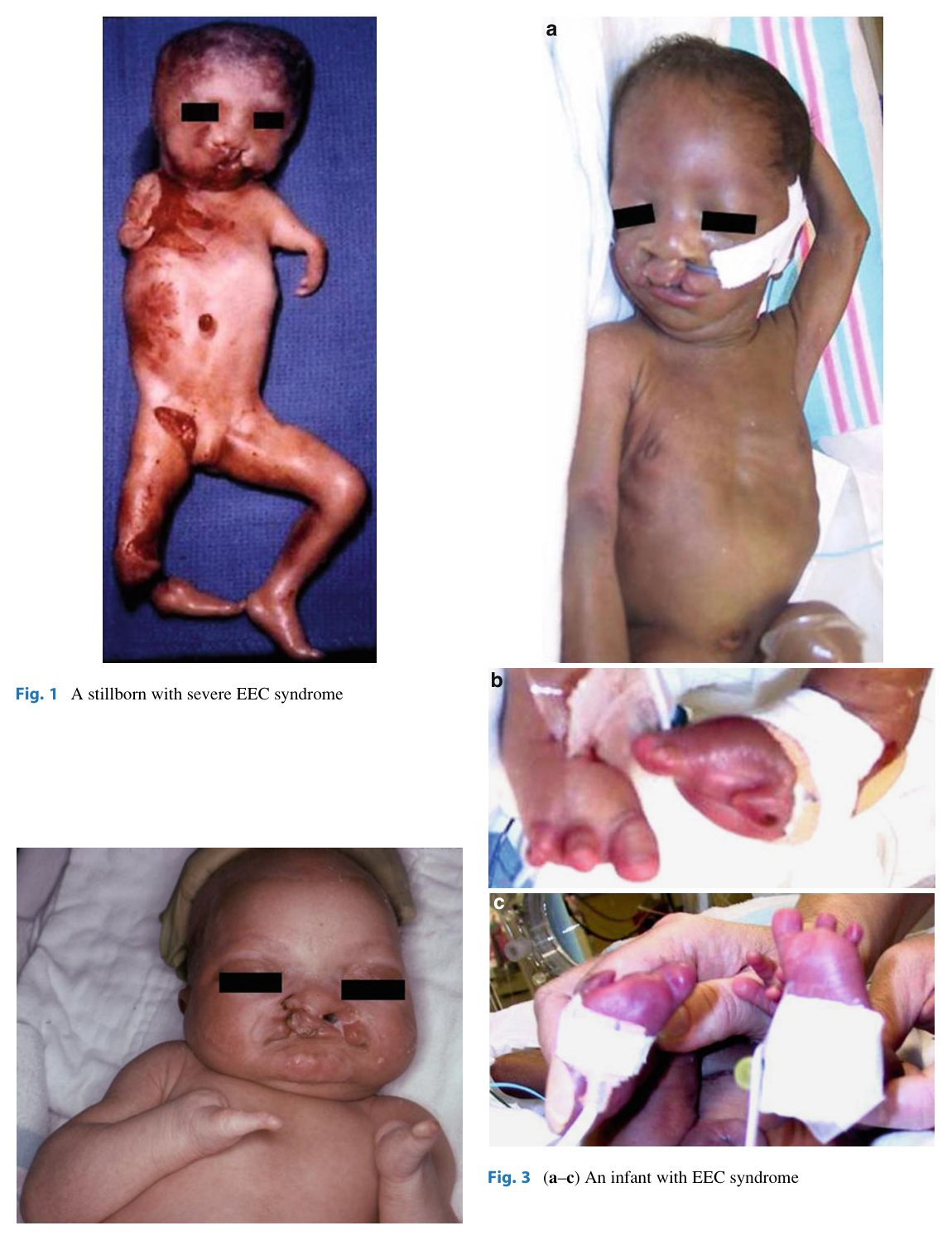
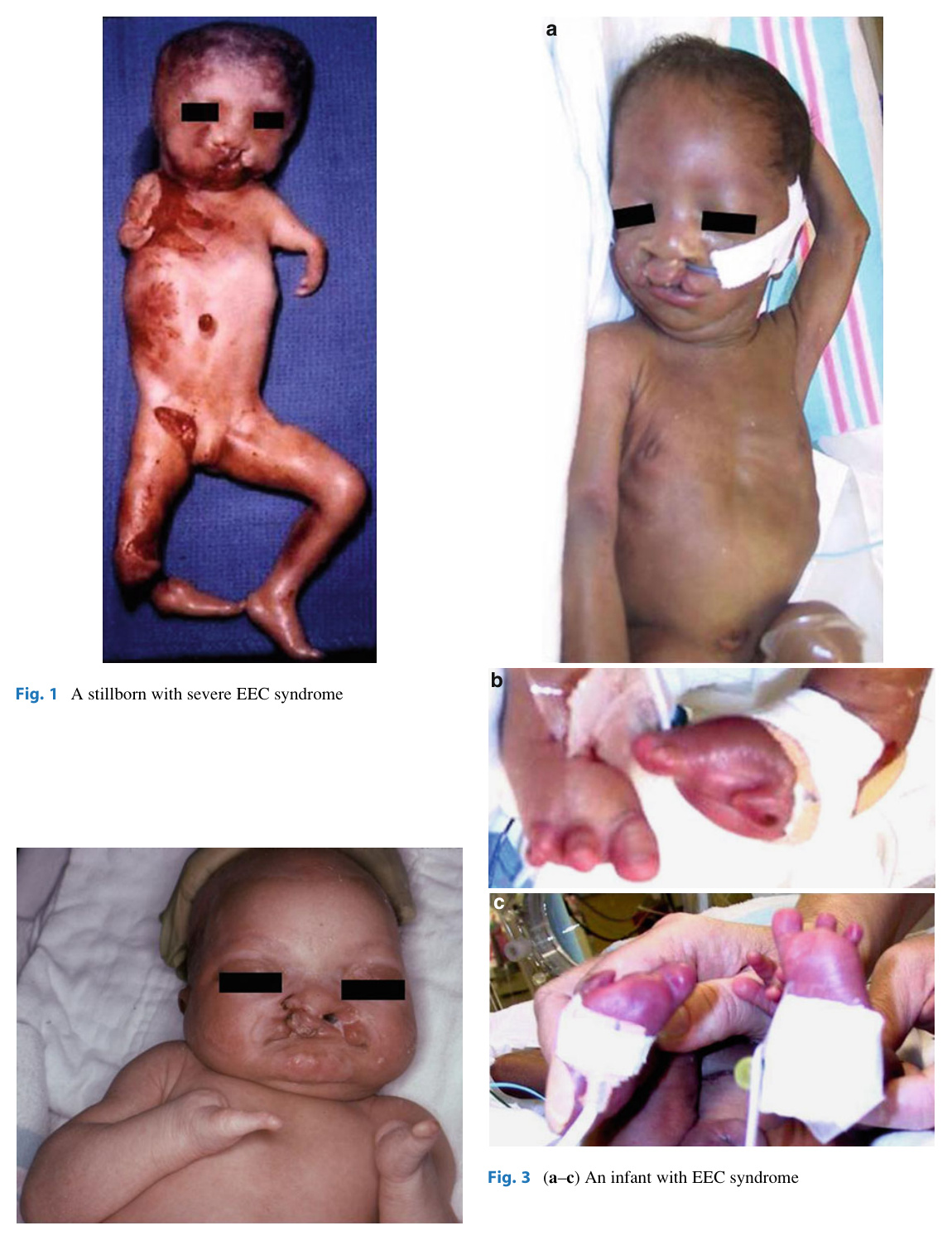
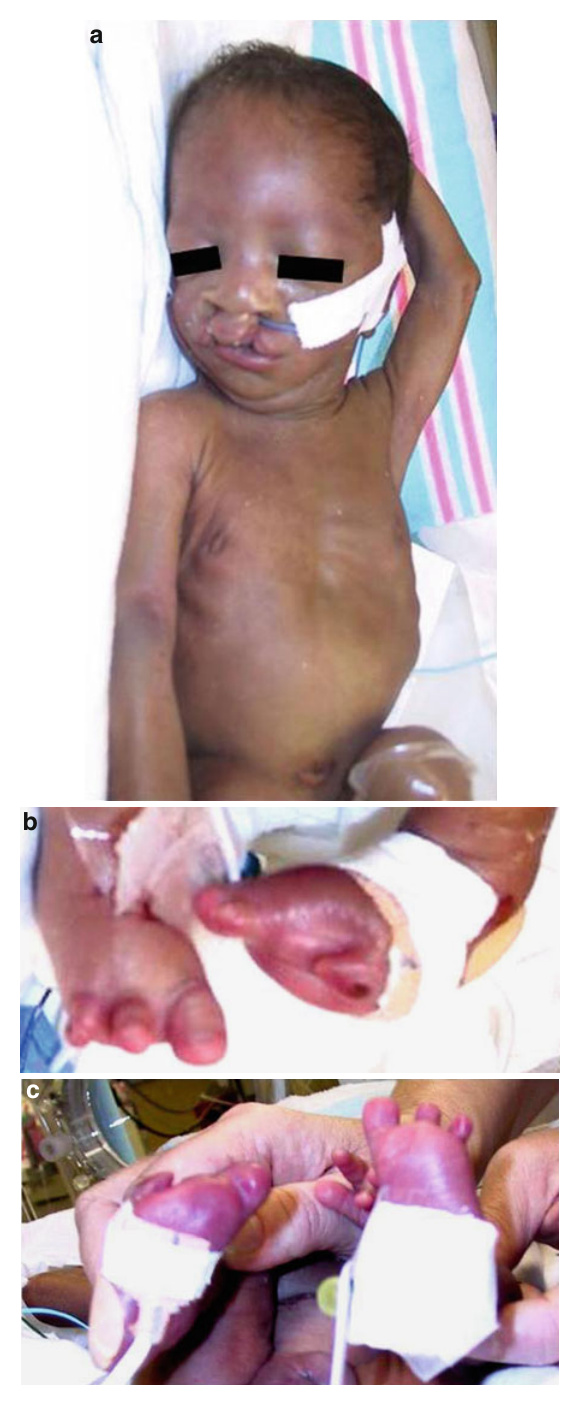
见于84%的病例,又称裂手/裂足畸形(split hand/foot malformation),表现为手和足中央性缩减(central reduction),常伴并指(趾)畸形(syndactyly)。可累及全部四个肢体、任意肢体组合,或完全不出现,高度可变。
外胚层发育不良(Ectodermal dysplasia)
见于77%的病例,可表现为:头皮毛发稀疏;眉毛及睫毛稀疏;指(趾)甲薄而脆;少汗症(hypohidrosis);皮肤薄而干燥,湿疹易感性增加;牙齿异常,包括缺牙(hypodontia)、锥形牙(coniform-shaped teeth)及釉质发育不良(enamel dysplasia)。
口面裂(Orofacial clefts)
双侧唇裂和/或腭裂见于68%的病例。特征性面容包括:上颌发育不良(maxillary hypoplasia)、人中短(short philtrum)、鼻尖宽(broad nasal tip)、后鼻孔闭锁(choanal atresia)。
泪管异常
泪管异常导致睑缘炎(blepharitis)、角膜炎(keratitis)及泪囊炎(dacryocystitis),见于59%的病例。
泌尿生殖系统缺陷
见于23%的病例,包括肾积水(hydronephrosis)、输尿管积水(hydroureter)、肾缺如(renal agenesis)。
传导性听力损失
见于14%的病例。
发育迟缓
可见发育迟缓。
偶发中枢神经系统畸形
包括:罕见的继发于下丘脑-垂体功能不全的生长激素缺乏;与前脑无裂畸形(holoprosencephaly)相关的低促性腺激素性性腺功能减退(hypogonadotropic hypogonadism)及中枢性尿崩症(central diabetes insipidus);孤立性透明隔缺如(isolated absent septum pellucidum)。
2. 主要体格检查体征 (Major Clinical Signs)
特征性面容
上颌发育不良、人中短、鼻尖宽、后鼻孔闭锁,可伴双侧唇裂和/或腭裂。
眼部体征
泪管异常所致睑缘炎、角膜炎、泪囊炎。
皮肤及毛发体征
头皮毛发稀疏、眉毛及睫毛稀疏、指(趾)甲薄而脆、皮肤薄而干燥伴湿疹易感性增加、少汗。
口腔牙齿体征
缺牙、锥形牙、釉质发育不良。
肢体体征
裂手/裂足畸形,中央性缩减,常伴并指(趾)。
3. 并发症与生命安全风险 (Complications / Risks)
- 反复眼部感染(睑缘炎、角膜炎、泪囊炎)
- 泪管阻塞
- 牙齿错颌畸形(dental malocclusion)及龋齿
- 传导性听力损失
- 泌尿生殖系统异常(肾积水、输尿管积水、肾缺如)
- 发育迟缓
- 偶发中枢神经系统畸形及相关内分泌缺陷(生长激素缺乏、低促性腺激素性性腺功能减退、中枢性尿崩症)
- 皮肤干燥及湿疹
4. 自然病程、寿命预后与致死性亚型 (Prognosis & Lethal Forms)
- 自然转归高度可变,取决于畸形严重程度及受累器官范围。
- 家族性病例外显率不完全(93%–98%),临床表达高度可变;散发病例表型通常更严重。
- 严重病例可致死胎(如Fig. 1所示严重EEC综合征死胎)。
- EEC综合征患者未显示癌症易感性增加。
- 通过多学科支持治疗及必要的外科干预,可改善功能及生活质量。
辅助检查与全解剖部位影像征象 (Diagnostic Investigations)
骨骼放射平片解剖细分、颅颈磁共振MRI、组织病理学及分子诊断流程
放射影像学特征(各解剖部位细分征象 Radiologic Features)
- 裂手畸形(中央性缩减)
- 并指畸形
- 指骨缺失或严重发育不良
- 裂足畸形(中央性缩减)
- 并趾畸形
- 趾骨缺失或严重发育不良
- 肾积水
- 输尿管积水
- 肾缺如
颅脑与颅颈交界区 MRI (Craniocervical MRI)
- 偶发中枢神经系统畸形:前脑无裂畸形(holoprosencephaly)
- 孤立性透明隔缺如(isolated absent septum pellucidum)
- 下丘脑-垂体区域异常(与生长激素缺乏、低促性腺激素性性腺功能减退及中枢性尿崩症相关)
生长板组织病理学 (Histology / Pathology)
- 皮肤组织病理学:外胚层发育不良相关改变,包括皮肤薄而干燥、毛囊及汗腺减少。
- 少汗症可通过淀粉-碘试验(starch-iodine test)证实:皮内注射毛果芸香碱(pilocarpine)刺激出汗后,皮肤涂以碘酊、风干后喷洒淀粉,以显示少汗。
分子与细胞遗传学检测策略 (Mutation Analysis)
- 直接分子分析可用于EEC综合征(TP63相关疾病)的检测。
- TP63基因突变分析:检测DNA结合结构域的杂合性错义突变。
- 产前分子遗传学分析:从绒毛膜绒毛取样(CVS)及羊水细胞提取胎儿DNA,通过直接测序及限制性内切酶消化(突变等位基因丢失AciI位点)进行检测。
- 可采用植入前遗传学诊断(preimplantation genetic diagnostic approach)。
遗传咨询、再发风险与全生命周期健康监护
生殖腺嵌合体风险量化、产前鉴别生长曲线及 AAP 临床监护规范
再发风险量化评估 (Recurrence Risk Assessment)
- 患者同胞:若父母一方患病,再发风险为50%;若父母双方均正常,再发风险不增加。
- 患者子代:再发风险为50%。
- 由于临床表达高度可变,遗传咨询存在困境。
- 需考虑性腺嵌合导致的不完全外显可能性。
产前筛查、超声鉴别与分子确诊路径 (Prenatal Diagnosis)
产前超声检查
可检测唇裂/腭裂、缺指(趾)畸形及相关异常。
分子遗传学分析
对p63基因突变进行产前分子遗传学分析:从CVS及羊水细胞提取胎儿DNA,通过直接测序及限制性内切酶消化(突变等位基因丢失AciI位点)检测;亦可采用植入前遗传学诊断方法。
临床健康监护与多学科干预方案 (Management & Health Supervision Protocol)
支持治疗(多学科团队协作)
人工泪液治疗泪管阻塞;预见并防治反复眼部感染;定期口腔科管理以预防牙齿错颌畸形及龋齿;使用简单润肤剂治疗皮肤干燥。
外科手术
泪管阻塞的早期手术;对所有导致功能损害的缺陷进行手术矫正,包括唇裂/腭裂、缺指(趾)畸形及相关异常。
权威原著参考文献 (References)
Harold Chen 著作全书收录之经典学术文献与循证医学来源
- Akahoshi K, Sakazume S, Kosaki K, et al. EEC syndrome type 3 with a heterozygous germline mutation in the P63 gene and B cell lymphoma. American Journal of Medical Genetics. 2003;120A:370–373.
- Annere´n G, Andersson T, Lindgren PG, et al. Ectrodactyly-ectodermal dysplasia-clefting syndrome (EEC): The clinical variation and prenatal diagnosis. Clinical Genetics. 1991;40:257–262.
- Barrow LL, van Bokhoven H, Daack-Hirsch S, et al. Analysis of the p63 gene in classical EEC syndrome, related syndromes, and non-syndromic orofacial clefts. Journal of Medical Genetics. 2002;39:559–566.
- Bigata` X, Bielsa I, Artigas M, et al. The ectrodactyly-ectodermal dysplasia-clefting syndrome (EEC): Report of five cases. Pediatric Dermatology. 2003;20:113–118.
- Bixler D, Spivack J, Bennett J, et al. The ectrodactyly-ectodermal dysplasia-clefting (EEC) syndrome. Report of 2 cases and review of the literature. Clinical Genetics. 1972;3:43–51.
- Bougeard G, Hadj-Rabia S, Faivre L. The Rapp–Hodgkin syndrome results from mutations of the TP63 gene. European Journal of Human Genetics. 2003;11:700–704.
- Bronshtein M, Gershoni-Baruch R. Prenatal transvaginal diagnosis of the ectrodactyly, ectodermal dysplasia, cleft palate (EEC) syndrome. Prenatal Diagnosis. 1993;13:519–522.
- Brunner HG, Hamel BC, van Bokhoven H. P63 gene mutations and human developmental syndromes. American Journal of Medical Genetics. 2002;112:284–290.
- Buss FW, Hughes HE, Clarke A. Twenty-four cases of the EEC syndrome: Clinical presentation and management. Journal of Medical Genetics. 1995;32:716–723.
- Celli J, Duijf P, Hamel BC, et al. Heterozygous germline mutations in the p53 homolog p63 are the cause of EEC syndrome. Cell. 1999;99:143–153.
- Chan I, Harper JI, Mellerio JE, et al. ADULT ectodermal dysplasia syndrome resulting from the missense mutation R298Q in the p63 gene. Clinical and Experimental Dermatology. 2004;29:669–672.
- Chan I, McGrath JA, Kivirikko S. Rapp–Hodgkin syndrome and the tail of p63. Clinical and Experimental Dermatology. 2005;30:183–186.
- Clements SE, Techanukul T, Coman D, et al. Molecular basis of EEC (ectrodactyly, ectodermal dysplasia, clefting) syndrome: Five new mutations in the DNA-binding domain of the TP63 gene and genotype-phenotype correlation. British Journal of Dermatology. 2010;162:201–207.
- Crackower MA, Scherer SW, Rommens JM, et al. Characterization of the split hand/split foot malformation locus SHFM1 at 7q21.3-q22.1 and analysis of a candidate gene for its expression during limb development. Human Molecular Genetics. 1996;5:571–579.
- Kosaki R, Ohashi H, Yoshihashi H, et al. A de novo mutation (R279C) in the P63 gene in a patient with EEC syndrome. Clinical Genetics. 2001;60:314–315.
- McGrath JA, Duijf PH, Doetsch V, et al. Hay-Wells syndrome is caused by heterozygous missense mutations in the SAM domain of p63. Human Molecular Genetics. 2001;10:221–229.
- Nardi AC, Ferreira U. Netto Junior NR: Urinary tract involvement in EEC syndrome: A clinical study in 25 Brazilian patients. American Journal of Medical Genetics. 1992;44:803–806.
- O’Quinn JR, Hennekam RC, Jorde LB, et al. Syndromic ectrodactyly with severe limb, ectodermal, urogenital, and palatal defects maps to chromosome 19. American Journal of Medical Genetics. 1992;62:130–135.
- Penchaszadeh VB, de Negrotti TC. Ectrodactyly-ectodermal dysplasia-clefting (EEC) syndrome: Dominant inheritance and variable expression. Journal of Medical Genetics. 1976;13:281–284.
- Qumsiyeh MB. EEC syndrome (ectrodactyly, ectodermal dysplasia and cleft lip/palate) is on 7p11.2-q21.3. Clinical Genetics. 1992;42:101.
- Rodini ES, Richieri-Costa A. EEC syndrome: Report on 20 new patients, clinical and genetic considerations. American Journal of Medical Genetics. 1990;37:42–53.
- Roelfsema NM, Cobben JM. The EEC syndrome: A literature study. Clinical Dysmorphology. 1996;5:115–127.
- Rollnick BR, Hoo JJ. Genitourinary anomalies are a component manifestation in the ectodermal dysplasia, ectrodactyly, cleft lip/palate (EEC) syndrome. American Journal of Medical Genetics. 1998;29:131–135.
- Scherer SW, Poorkaj P, Massa H, et al. Physical mapping of the split hand/split foot locus on chromosome 7 and implication in syndromic ectrodactyly. Human Molecular Genetics. 1994;3:1345–1354.
- South AP, Ashton GH, Willoughby C, et al. EEC (Ectrodactyly, Ectodermal dysplasia, Clefting) syndrome: Heterozygous mutation in the p63 gene (R279H) and DNA-based prenatal diagnosis. British Journal of Dermatology. 2002;146:216–220.
- Tse K, Temple IK, Baraitser M. Dilemmas in counseling: The EC syndrome. Journal of Medical Genetics. 1990;27:752–755.
- Van Bokhoven H, Hamel BCJ, Bamshad M, et al. p63 gene mutations in EEC syndrome, Limb-Mammary syndrome, and isolated split hand-split foot malformation suggest a genotype-phenotype correlation. American Journal of Human Genetics. 2001;69:481–492.
- Van Bolhoven H, Jung M, Smits AP, et al. Limb mammary syndrome: A new genetic disorder with mammary hypoplasia, ectrodactyly, and other hand/foot anomalies maps to human chromosome 3q27. American Journal of Human Genetics. 1999;64:538–546.
- Van Maldergem L, Gillerot Y, Vamos E, et al. Vasopressin and gonadotropin deficiency in a boy with the ectrodactyly-ectodermal dysplasia-clefting syndrome. Acta Paediatrica. 1992;81:365–367.
- Wessagowit V, Mellerio JE, Pembroke AC, et al. Heterozygous germline missense mutation in the p63 gene underlying EEC syndrome. Clinical and Experimental Dermatology. 2000;25:441–443.