丑角鱼鳞病
(Harlequin Ichthyosis) 皮肤与外胚层发育不良 OMIM: 242500 全本详注版| 致病基因 / 机制 | 染色体定位 | 遗传方式 | 发病率估计 |
|---|---|---|---|
| ABCA12 | 2q34 | 常染色体隐性 | 罕见,具体发病率未明确,但为最严重的先天性鱼鳞病 |
疾病概述与分子发病机理 (Genetics & Basic Defects)
流行病学数据、致病突变位点、信号转导通路及组织病理生理学
流行病学与全篇概述
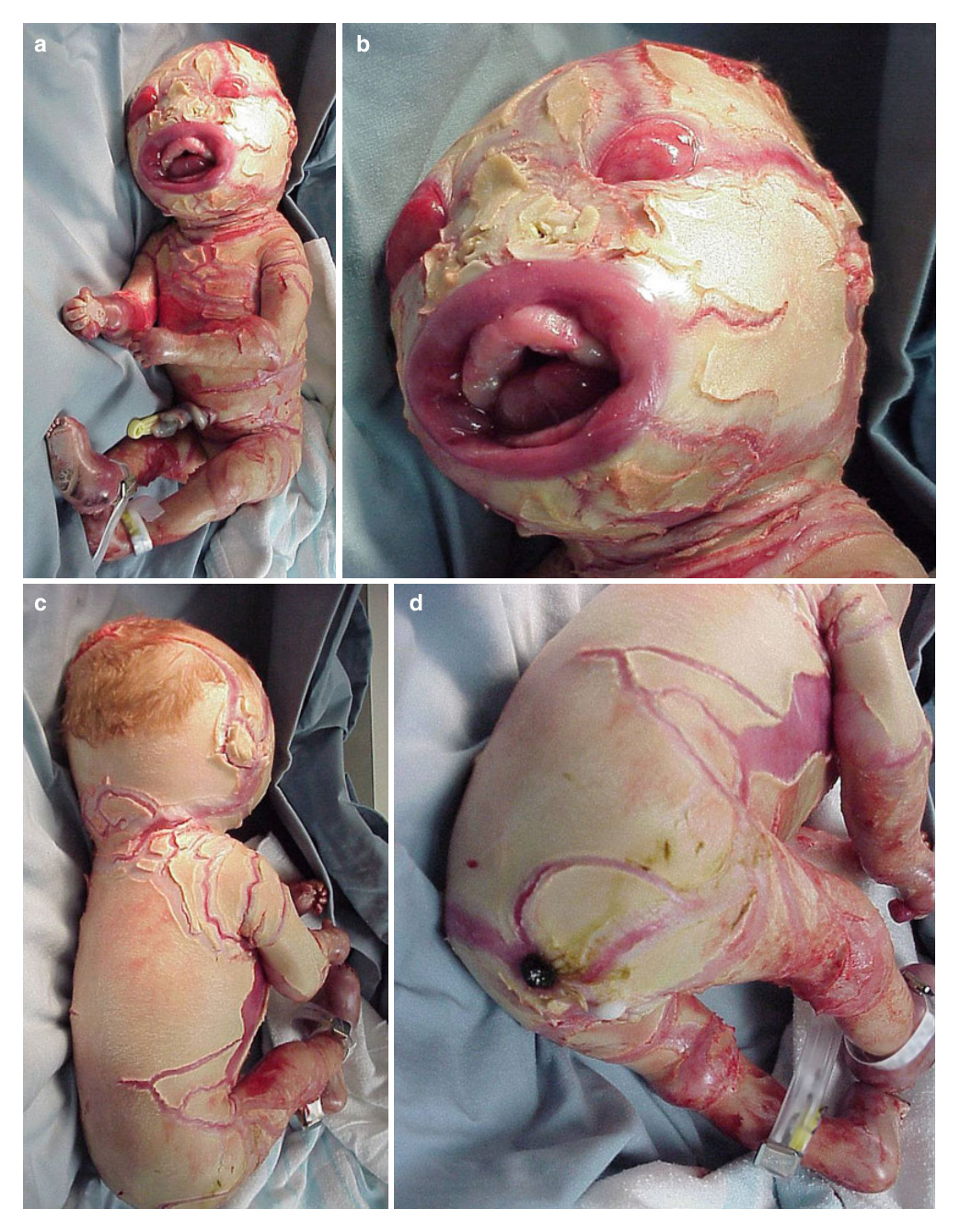
丑角鱼鳞病(Harlequin ichthyosis)是一种罕见的严重脱屑性疾病,是最具破坏性的先天性鱼鳞病,在子宫内即表现出来,且常在生命早期致命。该病以全身覆盖大而厚、黄白色盔甲样斑块(板状鳞屑)为特征,伴有红色湿润的裂隙和裂纹,面部呈现怪异外观,包括眼睑外翻、唇外翻、扁平鼻、皱褶/扁平耳以及肿胀/半屈曲的僵硬肢体。该病为常染色体隐性遗传,由ABCA12基因功能丧失性突变引起。患儿常因早产、呼吸受限、感染、体温过低、脱水、营养不良、严重贫血和肾功能衰竭而在围产期死亡。少数存活者可能有神经系统损害、身材矮小、生长发育迟缓,并因眼睑外翻而有严重角膜炎风险。
遗传模式与家系特征
常染色体隐性遗传。患者同胞的再发风险为25%。患者通常不能存活至生育年龄,因此其子代风险可忽略。近亲婚配家族史可增加风险。
致病基因与突变谱系
致病基因ABCA12位于染色体2q34,包含53个外显子,编码一个2595个氨基酸的蛋白质,属于ATP结合盒转运蛋白家族。突变类型包括:截短突变(无义突变、移码突变(缺失/插入突变)、剪接位点突变)最为常见;错义突变;外显子缺失;单氨基酸缺失。已报道一例由完全父源同二体性导致的新纯合突变p.R287X,绒毛膜绒毛核型分析显示非嵌合染色体2三体,而产后外周血核型为正常女性,提示三体自救是导致胚胎中ABCA12突变纯合化的突变级联步骤之一。另有一例男性患者携带新发18号染色体长臂缺失[46,XY,del(18)(q21.3)],提示基因可能位于该缺失区域内。
组织病理生理机制与解剖学缺陷
ABCA12突变导致角质形成细胞颗粒层中板层颗粒异常,以及角质层细胞外脂质板层缺失。ABCA12功能缺失导致上层角化表皮细胞中板层颗粒脂质转运障碍,进而导致角质层细胞间脂质层形成异常。来自携带ABCA12突变的丑角鱼鳞病患者的培养表皮角质形成细胞显示葡萄糖神经酰胺转运缺陷,该表型可通过体外ABCA12矫正基因转移恢复。对三例携带ABCA12突变患者的培养角质形成细胞研究显示葡萄糖神经酰胺转运明显受扰。
权威原著彩色临床图谱库 共 1 套超清图解
原著 200 DPI 高清无损裁切 • 完整保留图面 a, b, c, d 子标识 • 点击图面唤起全屏无损灯箱
临床表型全貌与自然转归 (Clinical Features)
主要症状、核心体征、严重度分型、各期并发症及长期预后
1. 主要临床症状 (Major Clinical Symptoms)
全身盔甲样斑块
大而厚、黄白色盔甲样斑块(板状鳞屑),伴有红色、湿润、渗出的裂隙和裂纹,覆盖全身。
严重眼睑外翻
眼睑非角化黏膜完全外翻,导致眼睛闭合。
唇外翻
唇部非角化黏膜外翻。
面部怪异外观
呈“蛙样”怪异面容。
耳部异常
耳朵皱褶、扁平。
鼻部异常
鼻尖扁平,鼻孔前倾(鼻发育不良)。
口部异常
嘴巴持续张开,无法正常吸吮。
肢体肿胀
因增厚角质层紧密包裹呈香肠样,导致肢体肿胀。
肢体僵硬
四肢半屈曲僵硬(肢体活动极少),伴有手指发育不良。
2. 主要体格检查体征 (Major Clinical Signs)
眉毛和睫毛缺失
眉毛和睫毛缺失。
头皮毛发缺失
头皮毛发缺失。
相关异常
肾小管缺陷、胸腺结构改变、肺发育不良。
3. 并发症与生命安全风险 (Complications / Risks)
- 呼吸受限(因机械性限制胸廓运动)
- 败血症
- 体温过低
- 脱水
- 营养不良
- 严重贫血
- 肾功能衰竭
- 严重角膜炎(因眼睑外翻)
- 早产
- 围产期死亡
4. 自然病程、寿命预后与致死性亚型 (Prognosis & Lethal Forms)
- 多数病例在围产期死亡,通常在出生后最初几周内,继发于呼吸受限、感染、体温过低、脱水、营养不良、严重贫血和肾功能衰竭。
- 少数存活者可能有不同程度的神经系统损害、身材矮小、生长发育迟缓,并因眼睑外翻而有严重角膜炎风险。
辅助检查与全解剖部位影像征象 (Diagnostic Investigations)
骨骼放射平片解剖细分、颅颈磁共振MRI、组织病理学及分子诊断流程
放射影像学特征(各解剖部位细分征象 Radiologic Features)
- 胎儿活动极少,肢体僵硬呈半屈曲位
- 肢体肿胀,手指和脚趾发育不良,指/趾骨短小
- 手部皱缩不能张开
- 特征性面部特征:面部轮廓扁平、眼睛睁开、眼睑外翻、白内障、鼻扁平、厚唇、唇外翻、耳形态异常(耳发育不良)、大张嘴、小颌畸形、眼前分隔状囊性结构
- 短颈
- 皮肤增厚
- 脉络丛囊肿
- 脐带短
- 羊水回声增强
- 无相关内脏异常
生长板组织病理学 (Histology / Pathology)
- 光镜检查:异常致密的角化过度(增厚的角化性角质层);毛囊和汗管中角质栓;颗粒层和角质层中板层小体缺失和大量囊泡;增厚角质层中角化细胞胞质内异常脂滴和空泡。
- 超微结构:增厚角质层中角化细胞胞质内异常脂滴和空泡;颗粒层角质形成细胞胞质中正常板层颗粒缺失;第一层角化细胞与颗粒细胞之间细胞外间隙缺乏板层结构。
- 皮肤样本生化分析:前丝聚蛋白向丝聚蛋白转化缺陷。
分子与细胞遗传学检测策略 (Mutation Analysis)
- 通过ABCA12基因测序或缺失/重复分析进行分子遗传学诊断。
- 产前诊断:在已确定致病突变的家庭中,可通过绒毛膜绒毛取样或羊膜腔穿刺进行DNA-based产前诊断,或进行植入前遗传学诊断。进行产前检测前必须明确受累家庭成员的两个致病等位基因。
遗传咨询、再发风险与全生命周期健康监护
生殖腺嵌合体风险量化、产前鉴别生长曲线及 AAP 临床监护规范
再发风险量化评估 (Recurrence Risk Assessment)
- 患者同胞的再发风险为25%。
- 患者子代风险:患者通常不能存活至生育年龄,因此子代风险可忽略。
产前筛查、超声鉴别与分子确诊路径 (Prenatal Diagnosis)
超声检查(2D、3D、4D)
在18-24周进行。可发现胎儿活动极少、肢体僵硬半屈曲位、肢体肿胀伴指/趾发育不良和短指/趾骨、手皱缩不能张开、特征性面部特征(面部轮廓扁平、眼睛睁开、眼睑外翻、白内障、鼻扁平、厚唇、唇外翻、耳形态异常、大张嘴、小颌畸形、眼前分隔状囊性结构)、短颈、皮肤增厚、脉络丛囊肿、脐带短、羊水回声增强,无相关内脏异常。
羊膜腔穿刺
羊水中角质形成细胞成团,含有脂滴和无定形电子致密物质。
胎儿皮肤活检电子显微镜检查
在20-22周通过胎儿镜获取皮肤活检标本。可见角化细胞中异常空泡和毛管中异常板层颗粒。
分子遗传学检测
在确定ABCA12为丑角鱼鳞病致病基因后,可通过绒毛膜绒毛或羊水样本进行DNA-based产前诊断,或进行植入前遗传学诊断。进行产前检测前必须明确受累家庭成员的两个致病等位基因。
临床健康监护与多学科干预方案 (Management & Health Supervision Protocol)
温度控制
维持体温。
电解质和液体平衡
维持电解质和液体平衡。
营养
保证足够的热量摄入。
感染预防
使用抗生素预防感染。
局部皮质类固醇
减少继发性炎症。
维A酸类药物
局部使用维A酸霜或软膏,或口服维A酸类药物以减少鳞屑。早期使用系统性维A酸类药物可促进角化过度斑块的加速脱落,而持续使用可减少鳞屑并改善眼睑外翻和唇外翻。
疼痛管理
使用抗炎药物,必要时使用硫酸吗啡。
眼部管理
intensive局部眼膏;及时治疗角膜炎;对于严重暴露性角膜炎或美容上不可接受的眼睑外翻,可行皮肤松解手术联合自体皮肤移植。
皮肤护理
小心处理,避免硬摩擦和物理接触,以防止水疱形成。
权威原著参考文献 (References)
Harold Chen 著作全书收录之经典学术文献与循证医学来源
- Akiyama, M. (1998). Severe congenital ichthyosis of the neonate. International Journal of Dermatology, 37, 722–728.
- Akiyama, M. (2006). Pathomechanisms of harlequin ichthyosis and ABCA transporters in human diseases. Archives of Dermatology, 142, 914–918.
- Akiyama, M. (2010). ABCA12 mutations and autosomal recessive congenital ichthyosis: A review of genotype/phenotype correlations and of pathogenetic concepts. Hum Mutation, 31, 1090–1096.
- Akiyama, M., & Shimizu, H. (2008). An update on molecular aspects of the nonsyndromic ichthyoses. Experimental Dermatology, 17, 373–382.
- Akiyama, M., Suzumori, K., & Shimizu, H. (1999). Prenatal diagnosis of harlequin ichthyosis by the examination of keratinized hair canals and amniotic fluid cells at 19 weeks’ estimated gestational age. Prenatal Diagnosis, 19, 167–171.
- Akiyama, M., Dale, B. A., Smith, L. T., et al. (1998). Regional difference in expression of characteristic abnormality of harlequin ichthyosis in affected fetuses. Prenatal Diagnosis, 18, 425–436.
- Akiyama, M., Sugryama-Nakagini, Y., Sakai, K., et al. (2005). Mutations in ABCA12 in harlequin ichthyosis and functional rescue by corrective gene transfer. The Journal of Clinical Investigation, 115, 1777–1784.
- Akiyama, M., Sakai, K., Sugiyama-Nakagiri, Y., et al. (2006). Compound heterozygous mutations including a de novo missense mutation in ABCA12 led to a case of harlequin ichthyosis with moderate clinical severity. The Journal of Investigative Dermatology, 126, 1518–1523.
- Akiyama, M., Titeux, M., Sakai, K., et al. (2007). DNA-based prenatal diagnosis of harlequin ichthyosis and characterization of ABCA12 mutation consequences. The Journal of Investigative Dermatology, 127, 568–573.
- Anton-Lamprecht, I. (1983). Genetically induced abnormalities of epidermal differentiation and ultrastructure in ichthyoses and epidermolyses: pathogenesis, heterogeneity, fetal manifestation, and prenatal diagnosis. J Inv Dermatol, 81(suppl), 149S–156S.
- Badden, H. P., Kubilus, J., Rosenbaum, K., et al. (1982). Keratinization in the harlequin fetus. Archives of Dermatology, 118, 14–18.
- Bale, S. J., Richards, G (2009) Autosomal recessive congenital ichthyosis. GeneReviews. Updated November 19, 2009. Available at: http://www.ncbi.nlm.nih.gov/bookshelf/br.fcgi?book=gene&part=li-ar
- Blanchet-Bardon, S., Dumez, Y., Labbe, F., et al. (1983). Prenatal diagnosis of a harlequin fetus using EM. Annales de Pathologie, 3, 321–325.
- Bongain, A., Benoit, B., Ejnes, L., et al. (2002). Harlequin fetus: three-dimensional sonographic findings and new diagnostic approach. Ultrasound in Obstetrics & Gynecology, 20, 82–85.
- Buxman, M. M., Goodkin, P. E., Fahrenback, W. H., et al. (1979). Harlequin ichthyosis with an epidermal lipid abnormality. Archives of Dermatology, 115, 189–193.
- Castiglia, D., Castori, M., Pisaneschi, E., et al. (2009). Trisomic rescue causing reduction to homozygosity for a novel ABCA12 mutation in harlequin ichthyosis. Clinical Genetics, 76, 392–397.
- Craig, J. M., Goldsmith, L. A., & Baden, H. P. (1970). An abnormality of keratin in the harlequin fetus. Pediatrics, 46, 437–440.
- Dale, B. A., Holbrook, K. A., Fleckman, P., et al. (1990). Heterogeneity in Harlequin ichthyosis, an inborn error of epidermal keratinization: variable morphology and structural protein expression and a defect in lamellar granules. J Inv Dermatol, 94, 6–18.
- Dale, B. A., & Kam, E. (1993). Harlequin ichthyosis. Variability in expression and hypothesis for disease mechanism. Archives of Dermatology, 129, 1471–1477.
- Harvey, H. B., Shaw, M. G., & Morrell, D. S. (2010). Perinatal management of harlequin ichthyosis: A case report and literature review. Journal of Perinatology, 30, 66–72.
- Hashimoto, K., & Khan, S. (1992). Harlequin fetus with abnormal lamellar granules and giant mitochondria. Journal of Cutaneous Pathology, 19, 247–252.
- Haftek, M., Cambazard, F., Dhouailly, D., et al. (1996). A longitudinal study of a harlequin infant presenting clinically as non-bullous congenital ichthyosiform erythroderma. British Journal of Dermatology, 135, 448–453.
- Kelsell, D. P., Norgett, E. E., Unsworth, H., et al. (2005). Mutations in ABCA12 underlie the severe congenital skin disease harlequin ichthyosis. American Journal of Human Genetics, 76, 794–803.
- Kudla, M. J., & Timmerman, D. (2010). Prenatal diagnosis of harlequin ichthyosis using 3- and 4-dimensional sonography. Journal of Ultrasound in Medicine, 29, 317–319.
- Lefèvre, C., Audebert, S., Jobard, F., et al. (2003). Mutations in the transporter ABCA12 are associated with lamellar ichthyosis type 2. Human Molecular Genetics, 12, 2369–2378.
- Moreau, S., & Salame, E. (1999). Goullet de Rugy M, et al: Harlequin fetus: A case report. Surgical and Radiologic Anatomy, 21, 215–216.
- Multani, A. S., Sheth, F. J., Shah, V. C., et al. (1996). Three siblings with harlequin ichthyosis in an Indian family. Early Human Development, 45, 229–233.
- Prasad, R. S., Pejaver, R. K., Hassan, A., et al. (1994). Management and follow-up of harlequin siblings. British Journal of Dermatology, 130, 650–653.
- Roberts, L. J. (1989). Long-term survival of a harlequin fetus. Journal of the American Academy of Dermatology, 21, 335–339.
- Sarkar, R., Sharma, R. C., Sethi, S., et al. (2000). Three unusual siblings with harlequin ichthyosis in an Indian family. Journal of Dermatology, 27, 609–611.
- Singh, S., Bhura, M., Maheshwari, A., et al. (2001). Successful treatment of harlequin ichthyosis with acitretin. International Journal of Dermatology, 40, 472–473.
- Stewart, H., Smith, P. T., Gaunt, L., et al. (2001). De novo deletion of chromosome 18q in a baby with harlequin ichthyosis. American Journal of Medical Genetics, 102, 342–345.
- Sybert, V. P. (1997). Genetic skin disorders (pp. 13–16). New York: Oxford University Press.
- Unamuno, P., Pierola, J. M., Fernandez, E., et al. (1987). Harlequin foetus in four siblings. British Journal of Dermatology, 116, 579–582.