I(1p), I(1q) 综合征
(I1p, I1q Syndrome) 染色体异常综合征 全本详注版| 致病基因 / 机制 | 染色体定位 | 遗传方式 | 发病率估计 |
|---|---|---|---|
| 未明确(可能涉及1号染色体上尚未鉴定的基因) | 1p 和 1q(1号染色体短臂和长臂) | 散发(新发染色体异常,非孟德尔遗传) | 极罕见,文献中仅报道一例 |
疾病概述与分子发病机理 (Genetics & Basic Defects)
流行病学数据、致病突变位点、信号转导通路及组织病理生理学
流行病学与全篇概述
I(1p), I(1q) 综合征是一种极罕见的染色体异常综合征,由Chen等(1999)首次描述。该综合征的特征为患者体内两条正常的1号染色体被一条等臂染色体1p [i(1p)] 和一条等臂染色体1q [i(1q)] 所取代,导致父源单亲等二体(uniparental isodisomy)。患者表现为身材矮小、上睑下垂、小颌/后缩颌、肌病、耳聋及不育。迄今文献中仅报道一例43岁女性患者,其临床表型涉及多系统,但智力正常。该病为散发,再发风险极低,患者几乎无法产生可存活后代。
遗传模式与家系特征
该病为散发的新发染色体异常,非孟德尔遗传。患者父母核型正常,患者再发风险未增加。患者本人因两条等臂染色体1的存在,理论上无法产生可存活后代。
致病基因与突变谱系
未发现特定致病基因。异常为染色体结构重排:两条正常1号染色体被一条i(1p)和一条i(1q)取代,导致父源单亲等二体(paternal uniparental isodisomy)。分子分析显示患者在所有检测的1号染色体位点上均为父源等位基因纯合(部分位点可能因减数分裂重组而存在杂合区域)。
组织病理生理机制与解剖学缺陷
发病机制可能为:受精卵仅含父源1号染色体(母源1号染色体因不分离而缺失),形成单体1概念体;随后着丝粒错误分裂产生两条等臂染色体(i(1p)和i(1q));在后续有丝分裂中两条等臂染色体进入同一子细胞,最终形成46,XX,i(1p),i(1q)核型。患者表型可能源于父源等二体导致的罕见隐性突变纯合化(unmasking of recessive mutations),或基因组印记(genomic imprinting)效应,或存在嵌合体(mosaicism)。肌病的存在提示潜在致病基因可能位于1号染色体。
权威原著彩色临床图谱库 共 4 套超清图解
原著 200 DPI 高清无损裁切 • 完整保留图面 a, b, c, d 子标识 • 点击图面唤起全屏无损灯箱
临床表型全貌与自然转归 (Clinical Features)
主要症状、核心体征、严重度分型、各期并发症及长期预后
1. 主要临床症状 (Major Clinical Symptoms)
身材矮小
患者表现为矮小症。
双侧传导性听力损失
听力障碍为传导性,双侧受累。
肌病
临床表现为肌病,具体类型未详细描述。
不育
患者经历三次婚姻,与不同伴侣均未能受孕,表现为原发性不育。
2. 主要体格检查体征 (Major Clinical Signs)
颅面特征
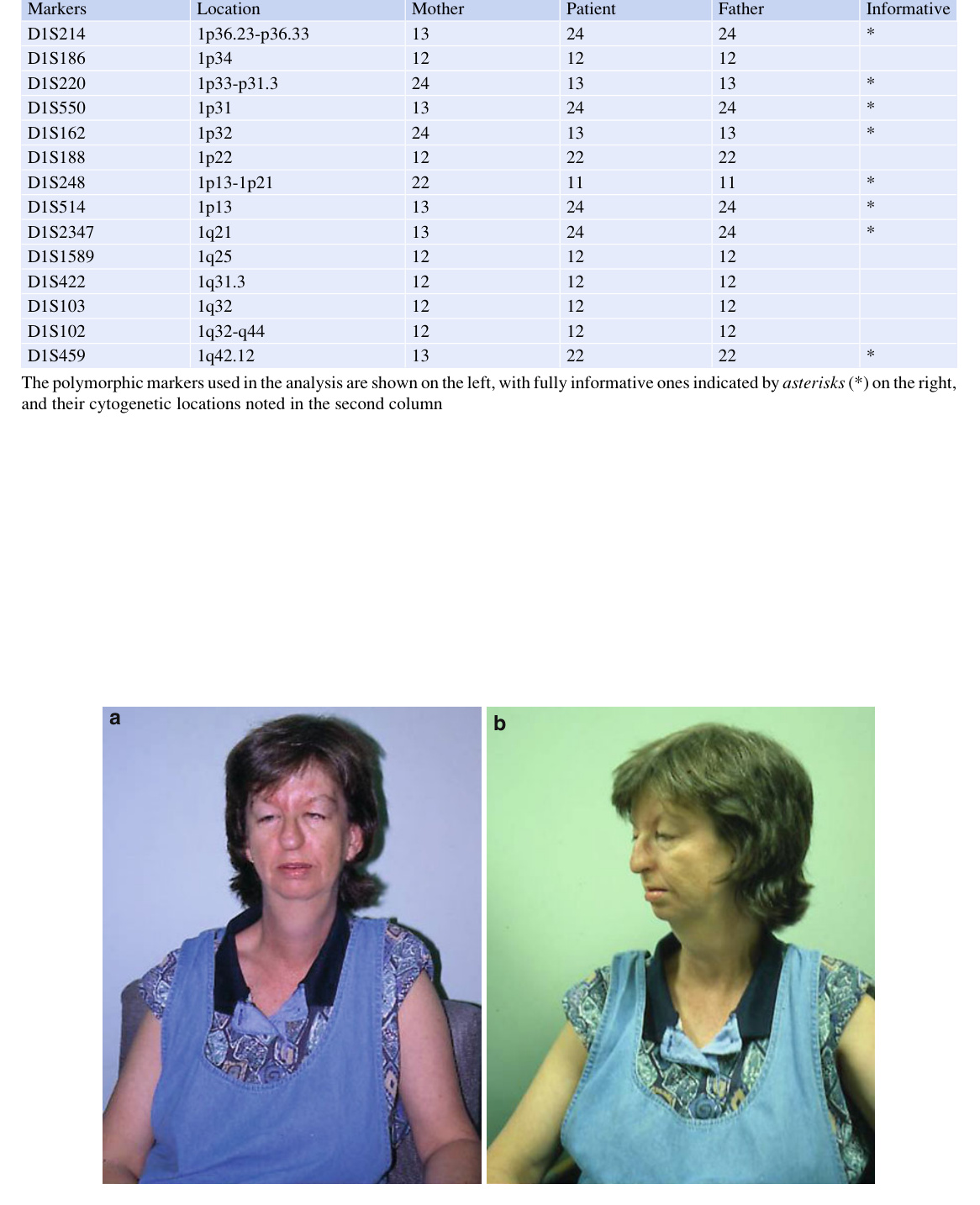
睑裂下斜(downward slant of palpebral fissures)、双侧上睑下垂(bilateral ptosis)、颧骨发育不良(malar hypoplasia)、严重小颌/后缩颌(severe micro/retrognathia)。
口腔
高腭弓(high-arched palate)。
脊柱
颈椎椎体异常(cervical vertebral anomaly)、脊柱侧弯(scoliosis)。
四肢
手指稍短(slightly short fingers)。
智力与性发育
智力正常;第二性征正常;11岁初潮,月经规律。
3. 并发症与生命安全风险 (Complications / Risks)
- 传导性听力损失影响言语发育(虽本例智力正常)
- 肌病可能导致运动耐力下降
- 脊柱侧弯可能进展
- 不育
4. 自然病程、寿命预后与致死性亚型 (Prognosis & Lethal Forms)
- 自然转归:患者寿命未明确报道,但截至43岁存活,智力正常,生活可自理。
- 生育预后:几乎无法产生可存活后代,因两条等臂染色体1导致减数分裂异常,配子将携带1p或1q的重复/缺失,对胎儿致死。
辅助检查与全解剖部位影像征象 (Diagnostic Investigations)
骨骼放射平片解剖细分、颅颈磁共振MRI、组织病理学及分子诊断流程
放射影像学特征(各解剖部位细分征象 Radiologic Features)
- 颈椎椎体异常
- 脊柱侧弯
颅脑与颅颈交界区 MRI (Craniocervical MRI)
- 未提供具体MRI特征,但颈椎异常可经影像学评估。
生长板组织病理学 (Histology / Pathology)
- 未提供组织病理学或超微电镜数据。
分子与细胞遗传学检测策略 (Mutation Analysis)
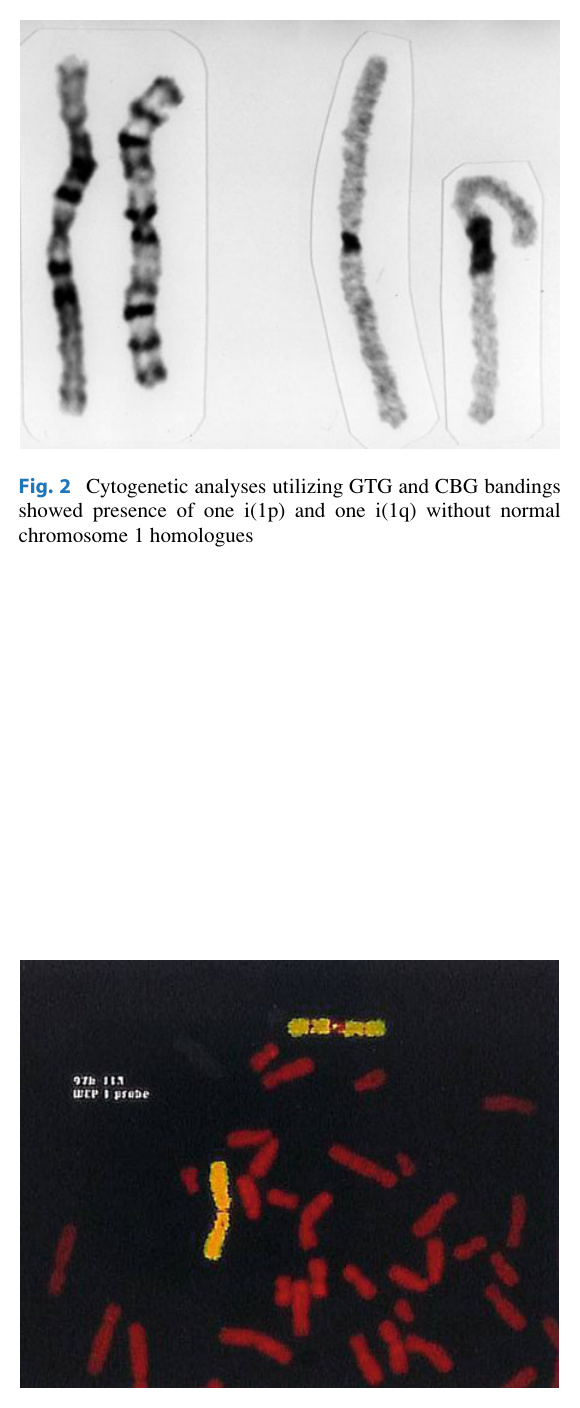
- G显带(GTG)和C显带(CBG)核型分析:显示一条i(1p)和一条i(1q),无正常1号染色体同源体。
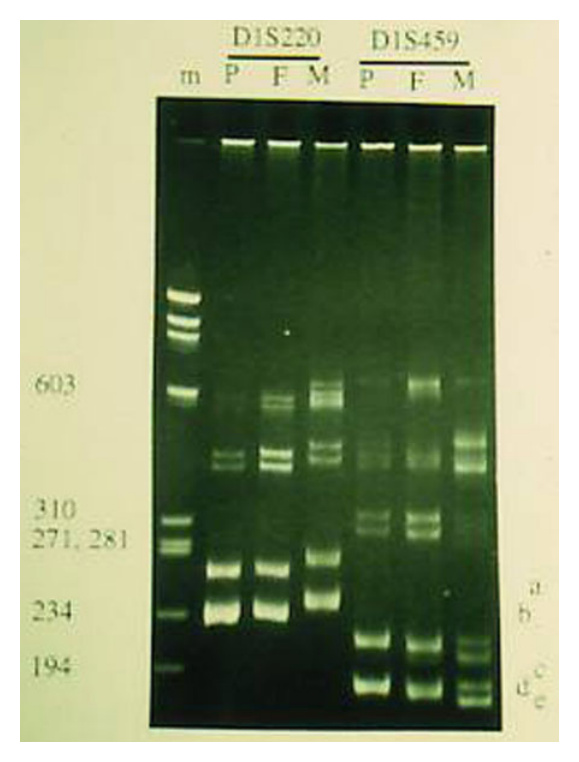
- 荧光原位杂交(FISH):使用1号染色体全染色体探针,仅显示两条染色体杂交信号,与G显带解释一致。
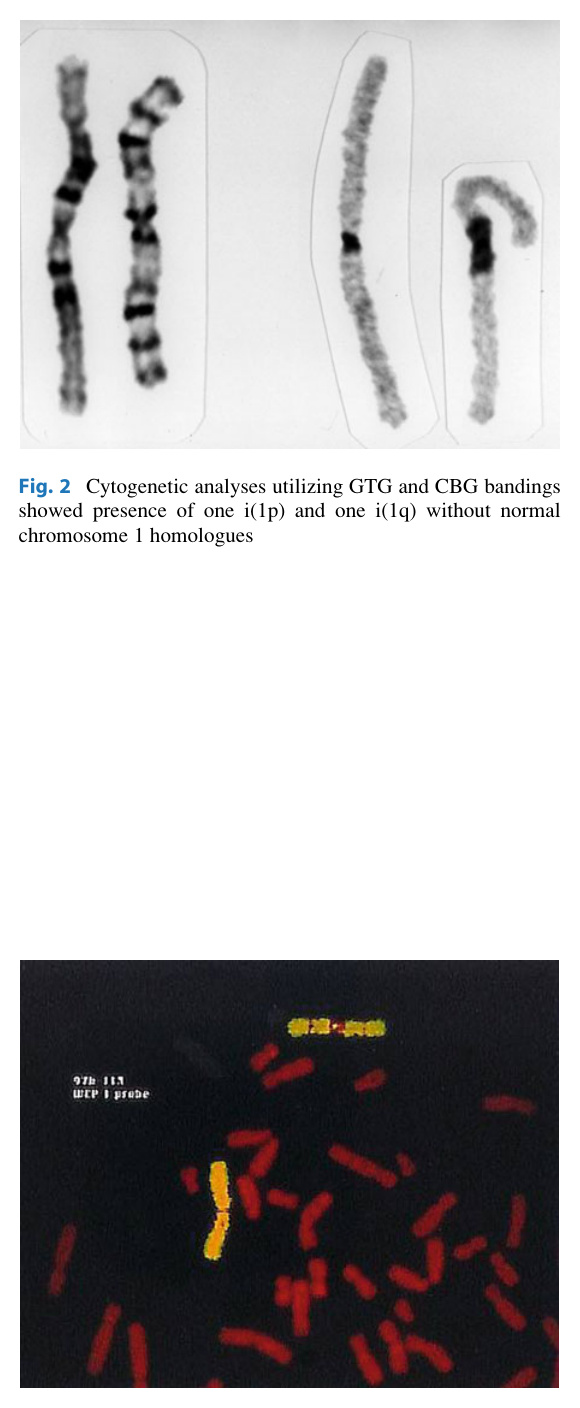
- PCR分析1号染色体多态性标记(如D1S220、D1S459等):证实患者仅继承父源等位基因,无母源等位基因,支持父源单亲等二体。
遗传咨询、再发风险与全生命周期健康监护
生殖腺嵌合体风险量化、产前鉴别生长曲线及 AAP 临床监护规范
再发风险量化评估 (Recurrence Risk Assessment)
- 患者同胞再发风险:未增加。
- 患者后代:几乎为零,因两条等臂染色体1将导致配子不平衡(1p或1q重复/缺失),对胎儿致死。
产前筛查、超声鉴别与分子确诊路径 (Prenatal Diagnosis)
绒毛膜绒毛取样(CVS)或羊膜腔穿刺
通过细胞遗传学分析(G显带、C显带、FISH)检测i(1p)和i(1q),确认无两条正常1号染色体。
临床健康监护与多学科干预方案 (Management & Health Supervision Protocol)
支持性治疗
多学科对症管理:听力评估与助听设备;肌病康复;脊柱侧弯监测;不育咨询。
权威原著参考文献 (References)
Harold Chen 著作全书收录之经典学术文献与循证医学来源
- Chen H, Young R, Mu X, et al. Uniparental isodisomy resulting from 46,XX,i(1p),i(1q) in a woman with short stature, ptosis, micro/retrognathia, myopathy, deafness, and sterility. American Journal of Medical Genetics. 1999;82:215–218.
- Spence JE, Perciaccante RG, Greig GM, et al. Uniparental disomy as a mechanism for human genetic disease. American Journal of Human Genetics. 1988;42:217–226.
- Bernasconi F, Karaguzel A, Celep F, et al. Normal phenotype with maternal isodisomy in a female with two isochromosomes: i(2p) and i(2q). American Journal of Human Genetics. 1996;59:1114–1118.
- Eggerding FA, Schonberg SA, Chehab FF, et al. Uniparental isodisomy for paternal 7p and maternal 7q in a child with growth retardation. American Journal of Human Genetics. 1994;55:253–265.
- Lindenbaum RH, Woods CG, Norbury CG, et al. An individual with maternal disomy of chromosome 4 and iso(4p), iso(4q). American Journal of Human Genetics. 1991;49(Suppl):A285.
- Shaffer LG, McCaskill C, Egli CA, et al. Is there an abnormal phenotype associated with maternal isodisomy for chromosome 2 in the presence of two isochromosomes? American Journal of Human Genetics. 1997;61:461–462.
- Pulkkinen L, Bullrich F, Czarnecki P, et al. Maternal uniparental disomy of chromosome 1 with reduction to homozygosity of the LAMB3 locus in a patient with Herlitz junctional epidermolysis bullosa. American Journal of Human Genetics. 1997;61:611–619.
- Gelb BD, Willner JP, Dunn TM, et al. Paternal uniparental disomy for chromosome 1 revealed by molecular analysis of a patient with pycnodysostosis. American Journal of Human Genetics. 1998;62:848–854.
- Takizawa Y, Pulkkinen L, Chao S-C, et al. Complete paternal uniparental isodisomy of chromosome 1: A novel mechanism for Herlitz junctional epidermolysis bullosa. Journal of Investigative Dermatology. 2000;115:307–311.
- Turner CLS, Bunyan DJ, Thomas S, et al. Zellweger syndrome resulting from maternal isodisomy of chromosome 1. American Journal of Medical Genetics Part A. 2007;143A:2172–2177.
- Baumer A, Bascaran S, Taralczak M, et al. Initial maternal meiotic I error leading to the formation of a maternal i(2q) and a paternal i(2p) in a healthy male. Cytogenetic and Genome Research. 2007;118:38–41.
- Albrecht B, Mergenthaler S, Eggermann K, et al. Uniparental isodisomy for paternal 2p and maternal 2q in a phenotypically normal female with two isochromosomes, i(2p) and i(2q). Journal of Medical Genetics. 2001;38:214–216.