皮埃尔·罗宾序列征
(Pierre Robin Sequence) 颅面与五官畸形综合征 全本详注版| 致病基因 / 机制 | 染色体定位 | 遗传方式 | 发病率估计 |
|---|---|---|---|
| GAD67, PVRL1, SOX9, TCOF1, COL2A1, COL11A1 | 2q24.1–33.3、4q32–qter、11q21–23.1、17q21–24.3(易感位点);具体基因定位:GAD67位于2q31,PVRL1位于11q23–q24,SOX9位于17q24.3–q25.1 | 多数为散发性;部分家系呈常染色体显性遗传;综合征型病因异质性大(单基因、染色体、致畸因素、变形、阻断、未知原因) | 约1/8,500活产儿 |
疾病概述与分子发病机理 (Genetics & Basic Defects)
流行病学数据、致病突变位点、信号转导通路及组织病理生理学
流行病学与全篇概述
皮埃尔·罗宾序列征(Pierre Robin Sequence)由Pierre Robin于1923年描述,核心特征为腭裂、小颌畸形(micrognathia)和舌下垂(glossoptosis)三联征。该序列征估计发病率约为1/8,500活产儿(Bush和Williams 1983)。其病因和表型高度异质,可为孤立性畸形序列,也可为多种单基因病、染色体异常、致畸物暴露、子宫内变形或阻断以及未知原因综合征的表现之一。发病机制涉及内在性下颌发育不良(malformation sequence)或外源性下颌受压(deformation sequence),前者如Treacher-Collins综合征、del(22q)综合征,后者如羊水过少(oligohydramnios)导致的子宫内压迫。舌下垂可导致上气道梗阻、呼吸暂停、喂养困难、发育迟缓及中耳疾病等。诊断需结合临床三联征、呼吸评估、纤维鼻咽镜、头影测量X线及分子遗传学检测。管理包括体位治疗、鼻胃管喂养、舌固定术、下颌骨牵引成骨术、腭裂修复及听力干预等。预后取决于是否合并综合征及气道梗阻的严重程度。
遗传模式与家系特征
多数病例为散发性。部分家系呈常染色体显性遗传模式。综合征型病因异质性强,可为单基因病(如Stickler综合征、Beckwith-Wiedemann综合征、Camptomelic综合征、脑肋下颌综合征、先天性强直性肌营养不良、远端关节挛缩-Robin综合征、下颌面骨发育不全、Miller-Dieker综合征、耳腭指综合征II型、Robin-少指综合征)、染色体异常(如del(22q)腭心面综合征、del(4q)综合征、del(6q)综合征、dup(11q)综合征)、致畸物暴露(胎儿酒精综合征、胎儿乙内酰脲综合征、胎儿三甲双酮综合征)、子宫内变形(羊水过少、子宫结构异常、羊膜带综合征)、阻断(羊膜带阻断)及未知原因(CHARGE综合征、股骨发育不全、Moebius序列征、Robin/无肢关联)。
致病基因与突变谱系
文献比较及细胞遗传学数据库分析提示与2q24.1–33.3、4q32–qter、11q21–23.1和17q21–24.3位点存在一定一致性。候选基因包括GAD67(2q31)、PVRL1(11q23–q24)和SOX9(17q24.3–q25.1)。特定综合征的分子缺陷:Treacher-Collins综合征为TCOF1突变;Stickler发育不良复合征为COL2A1或COL11A1突变;先天性脊椎骨骺发育不良复合征为COL2A1突变。
组织病理生理机制与解剖学缺陷
基于内在性下颌发育不良的畸形序列:下颌发育不全阻止舌正常下降,干扰腭突融合,如Treacher-Collins综合征、del(22q)综合征。基于外源性下颌发育不良的变形序列:子宫内约束(如羊水过少导致颏部压迫胸骨,限制下颌生长,舌被夹于腭突之间)所致,出生后解除子宫内变形力后下颌可出现追赶性生长。神经源性肌张力低下导致下颌运动缺乏。结缔组织发育不良:Stickler发育不良复合征、先天性脊椎骨骺发育不良复合征。
权威原著彩色临床图谱库 共 1 套超清图解
原著 200 DPI 高清无损裁切 • 完整保留图面 a, b, c, d 子标识 • 点击图面唤起全屏无损灯箱
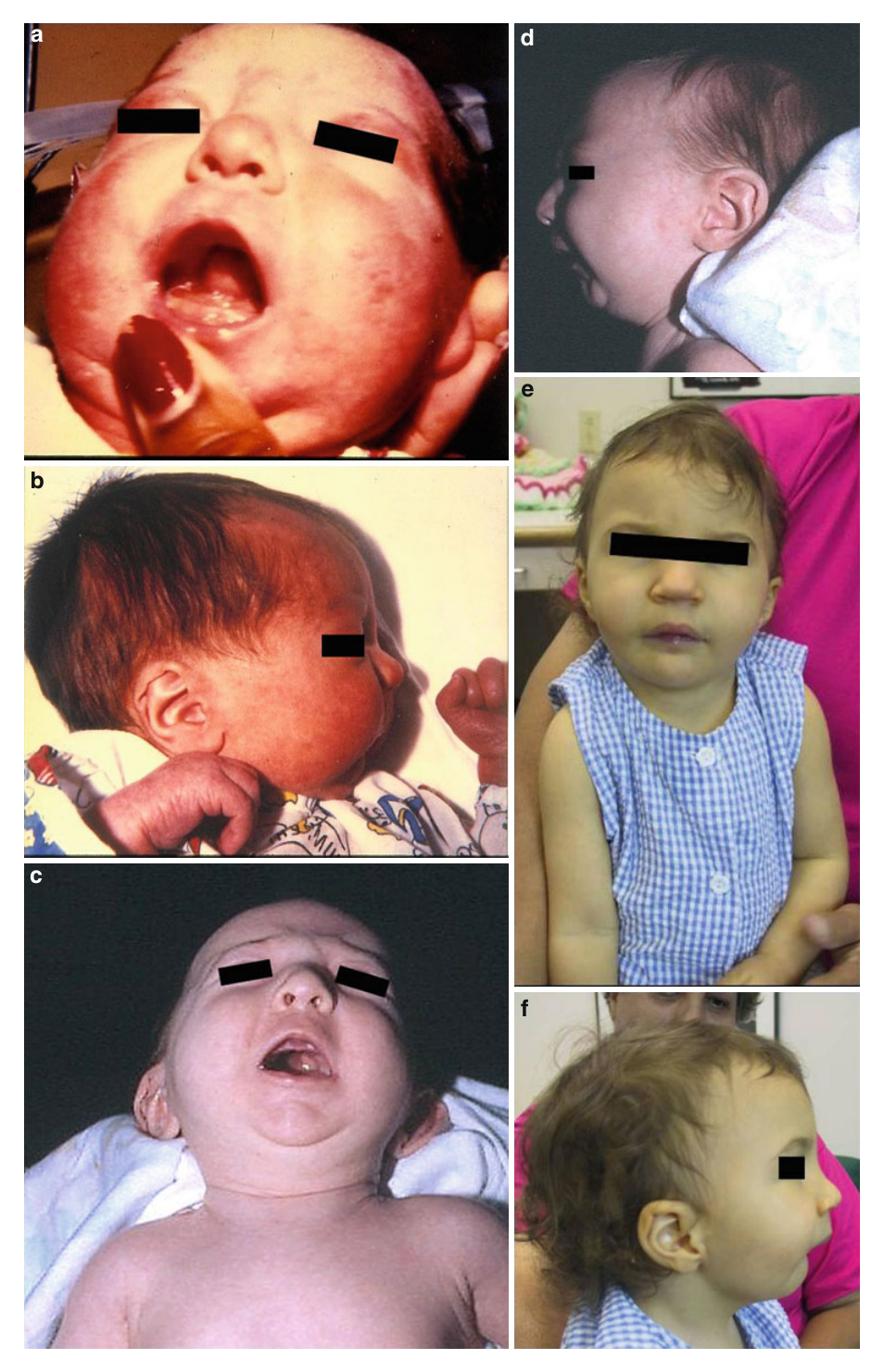
临床表型全貌与自然转归 (Clinical Features)
主要症状、核心体征、严重度分型、各期并发症及长期预后
1. 主要临床症状 (Major Clinical Symptoms)
呼吸窘迫
常为引起关注的第一个体征,与喂养相关;不一定在出生时即出现。可表现为上气道梗阻和呼吸暂停,由上气道塌陷所致,继发于舌下垂伴下颌后缩、咽部肌张力低下、喉软化、喉裂、喉蹼。持续气道梗阻可导致喂养困难、生长迟缓、漏斗胸、肺功能下降及猝死。
喂养困难与生长迟缓
因气道梗阻和腭裂导致喂养效率低下,长期可致生长迟缓(failure to thrive)。
发育迟缓
孤立性Robin序列征通常无发育迟缓;若存在发育迟缓,多取决于潜在综合征。
中耳疾病
与腭裂相关,包括中耳炎(80%)、耳廓异常(75%)、听力损失(多为传导性,60%)。
腭裂相关问题
言语缺陷、腭咽闭合不全。
下颌追赶性生长
因机械性约束所致者,下颌生长可正常追赶;内在性下颌异常者下颌生长持续不足。
2. 主要体格检查体征 (Major Clinical Signs)
经典三联征
后位U形腭裂;小颌畸形/下颌后缩(micrognathia/retrognathia);舌下垂(glossoptosis,舌向后移动阻塞口咽部的倾向)。
替代诊断标准
下颌缺陷、腭裂、上气道梗阻。
其他体征
根据潜在病因不同,可出现其他体征、症状及相关畸形。
3. 并发症与生命安全风险 (Complications / Risks)
- 上气道梗阻和呼吸暂停
- 生长迟缓
- 漏斗胸
- 肺功能下降
- 猝死
- 中耳炎及传导性听力损失
- 言语缺陷
- 腭咽闭合不全
4. 自然病程、寿命预后与致死性亚型 (Prognosis & Lethal Forms)
- 孤立性Robin序列征且无严重气道梗阻者预后一般良好;合并综合征或严重气道梗阻者预后取决于原发病及呼吸管理;持续气道梗阻可致猝死。
辅助检查与全解剖部位影像征象 (Diagnostic Investigations)
骨骼放射平片解剖细分、颅颈磁共振MRI、组织病理学及分子诊断流程
放射影像学特征(各解剖部位细分征象 Radiologic Features)
- 变形序列:下颌骨体短、升支短、下颌角增大、追赶性生长不完全;颅底角减小
- Treacher-Collins综合征:下颌骨体短、升支短、特征性形态、生长严重受累;颅底角减小
- del(22q11.2)综合征:下颌后缩、形态基本正常;颅底角增大
- Stickler发育不良复合征:升支短、下颌骨体角前切迹;颅底角减小
- 先天性脊椎骨骺发育不良复合征:下颌骨体短
颅脑与颅颈交界区 MRI (Craniocervical MRI)
- 纤维鼻咽镜评估上气道梗阻机制及咽、腭、舌、喉形态与功能(原文未提供MRI特征)
生长板组织病理学 (Histology / Pathology)
- 原文未提供组织病理学与超微电镜结构描述
分子与细胞遗传学检测策略 (Mutation Analysis)
- 染色体分析检测del(22q11.2)
- 分子诊断:Treacher-Collins综合征检测TCOF1突变;Stickler发育不良复合征检测COL2A1、COL11A1突变;先天性脊椎骨骺发育不良复合征检测COL2A1突变
遗传咨询、再发风险与全生命周期健康监护
生殖腺嵌合体风险量化、产前鉴别生长曲线及 AAP 临床监护规范
再发风险量化评估 (Recurrence Risk Assessment)
- 患者同胞再发风险低,除非Pierre Robin序列征为某综合征的一部分
- 患者子代再发风险低,除非Pierre Robin序列征为某综合征的一部分
产前筛查、超声鉴别与分子确诊路径 (Prenatal Diagnosis)
产前超声
可显示小颌畸形/下颌后缩及腭裂
临床健康监护与多学科干预方案 (Management & Health Supervision Protocol)
体位管理
婴儿俯卧位有助于防止舌和下颌阻塞气道,通常可改善氧饱和度。
喂养支持
早期放置鼻胃管喂养。
腭部异常作业治疗
针对腭部异常的作业治疗。
气道梗阻外科干预
舌固定术(glossopexy)将舌向前固定于前部结构以防舌后坠入气道;保守治疗失败者需行气管切开术;下颌骨牵引成骨术(手术切开下颌骨后施加牵引以刺激新骨生成);腭裂修复。
中耳炎治疗
抗生素治疗;鼓膜置管术。
言语治疗
言语治疗。
权威原著参考文献 (References)
Harold Chen 著作全书收录之经典学术文献与循证医学来源
- Argamaso, R. V. (1992). Glossopexy for upper airway obstruction in Robin sequence. Cleft Palate Craniofacial Journal, 29, 232–238.
- Bath, A. P., & Bull, P. D. (1997). Management of upper airway obstruction in Pierre Robin sequence. Journal of Laryngology and Otology, 111, 1155–1157.
- Bush, P., & Williams, A. (1983). Incidence of the Robin anomalad. British Journal of Plastic Surgery, 36, 434–437.
- Caouette-Laberge, L., Bayet, B., & Larocque, Y. (1994). The Pierre Robin sequence: Review of 125 cases and evolution of treatment modalities. Plastic and Reconstructive Surgery, 93, 934–941.
- Carey, J., Fineman, R., & Ziter, F. (1982). The robin sequence as a consequence of malformation, dysplasia, and neuromuscular syndromes. Journal of Pediatrics, 101, 858–864.
- Cohen, M. M., Jr. (1976). The Robin anomalad – its nonspecificity and associated syndromes. Journal of Oral Surgery, 34, 587–593.
- Cohen, M. M., Jr. (1982). The child with multiple birth defects. New York: Raven.
- Cohen, M. M., Jr. (1999). Robin sequences and complexes: Causal heterogeneity and pathogenetic/phenotypic variability. American Journal of Medical Genetics, 84, 311–315.
- Hanson, J. W., & Smith, D. W. (1975). U-shaped palatal defect in the Robin anomaly: Developmental and clinical relevance. Journal of Pediatrics, 87, 30.
- Heaf, D., Jelms, P., Dinwiddie, R., et al. (1982). Nasopharyngeal airways in Pierre Robin syndrome. Journal of Pediatrics, 100, 698–703.
- Holder-Espinasse, M., Abadie, V., Cormier-Daire, V., et al. (2001). Pierre Robin sequence: A series of 117 consecutive cases. Journal of Pediatrics, 139, 588–590.
- Hsieh, Y.-Y., et al. (1999). The prenatal diagnosis of Pierre Robin sequence. Prenatal Diagnosis, 19, 567–569.
- Jakobsen, L. P., Knudsen, M. A., Lespinasse, J., et al. (2006). Genetic basis of the Pierre robin sequence. The Cleft Palate-Craniofacial Journal, 43, 155–159.
- Jamshidi, N., Macciocca, I., Dargaville, P. A., et al. (2004). Isolated Robin sequence associated with a balanced t(2;17) chromosomal translocation. Journal of Medical Genetics, 41, e1–e5.
- Marques, I., Barbieri, M., & Bettiol, H. (1998). Etiopathogenesis of isolated Robin sequence. The Cleft Palate-Craniofacial Journal, 35, 517–525.
- Myer, C. M., III, Reed, J. M., Cotton, R. T., et al. (1998). Airway management in Pierre Robin sequence. Otolaryngology and Head and Neck Surgery, 118, 630–635.
- Pilu, G., Rombero, R., Reece, A., et al. (1986). The prenatal diagnosis of Robin anomalad. American Journal of Obstetrics and Gynecology, 154, 630–632.
- Randall, P., Krogman, W. M., & Jahina, S. (1965). Pierre Robin and the syndrome that bears his name. The Cleft Palate Journal, 2, 237–244.
- Robin, P. (1923). La chute de la base de la langue considérée comme une nouvelle cause de gêne dans la respiration nasopharyngienne. Bulletin de l'Académie nationale de médecine (Paris), 89, 37–41.
- Sheffield, L. J., et al. (1987). A genetic follow-up study of 64 patients with the Pierre Robin complex. American Journal of Medical Genetics, 28, 25–37.
- Sher, A. E. (1992). Mechanisms of airway obstruction in Robin sequence: Implications for treatment. Cleft Palate-Craniofacial Journal, 29, 224–231.
- Shprintzen, R. J. (1988). Pierre Robin, micrognathia, and airway obstruction: The dependency of treatment on accurate diagnosis. International Anesthesiology Clinics, 26, 64–71.
- Shprintzen, R. J. (1992). The implications of the diagnosis of Robin sequence. Cleft Palate-Craniofacial Journal, 29, 205–209.
- Shprintzen, R. J. (2001). Robin sequence. In S. B. Cassidy & J. E. Allanson (Eds.), Management of genetic syndromes (pp. 323–336). New York: Wiley-Liss.
- Shprintzen, R. J., Siegel-Sadewitz, V. L., Amato, J., et al. (1985). Anomalies associated with cleft lip, cleft palate, or both. American Journal of Medical Genetics, 20, 585–596.
- Sidhu, S. S., & Deshmukh, R. N. (1989). Pierre Robin syndrome: Autosomal dominant inheritance with pleiotropic effect. Indian Journal of Pediatrics, 56, 413–417.
- Snead, M., & Yates, J. (1999). Clinical and molecular genetics of Stickler syndrome. Journal of Medical Genetics, 36, 353–359.
- Spranger, J. W., Benirschke, K., Hall, J. G., et al. (1982). Errors of morphogenesis: Concepts and terms. Journal of Pediatrics, 100, 160–165.
- Taylor, M. R. G. (2001). The Pierre Robin sequence: A concise review for the practicing pediatrician. Pediatrics in Review, 22, 125–130.
- Tewfik, T. L., Trinh, N., Teebi, A. S. (2010). Pierre robin syndrome. eMedicine from WebMD. Retrieved March 4, 2010. Available at: http://emedicine.medscape.com/article/844143-overview
- Van den Elzen, A. P. M., Semmekrot, B. A., Bongers, E. M. H. F., et al. (2001). Diagnosis and treatment of the Pierre Robin sequence: Results of a retrospective clinical study and review of the literature. European Journal of Pediatrics, 160, 47–53.
- Vegter, F., Hage, J. J., & Mulder, J. W. (1999). Pierre Robin syndrome: Mandibular growth during the first year of life. Annals of Plastic Surgery, 42, 154–157.
- William, A. (1981). The Robin anomalad – a follow-up study. Archives of Disease in Childhood, 56, 663–668.