牙关紧闭-假性屈曲指综合征
(Trismus-Pseudocamptodactyly Syndrome) 骨骼与结缔组织遗传病 OMIM: 158300 全本详注版| 致病基因 / 机制 | 染色体定位 | 遗传方式 | 发病率估计 |
|---|---|---|---|
| MYH8 | 17p13.1 | 常染色体显性遗传 | 相对罕见的遗传性疾病,具体发病率未明确报道 |
疾病概述与分子发病机理 (Genetics & Basic Defects)
流行病学数据、致病突变位点、信号转导通路及组织病理生理学
流行病学与全篇概述
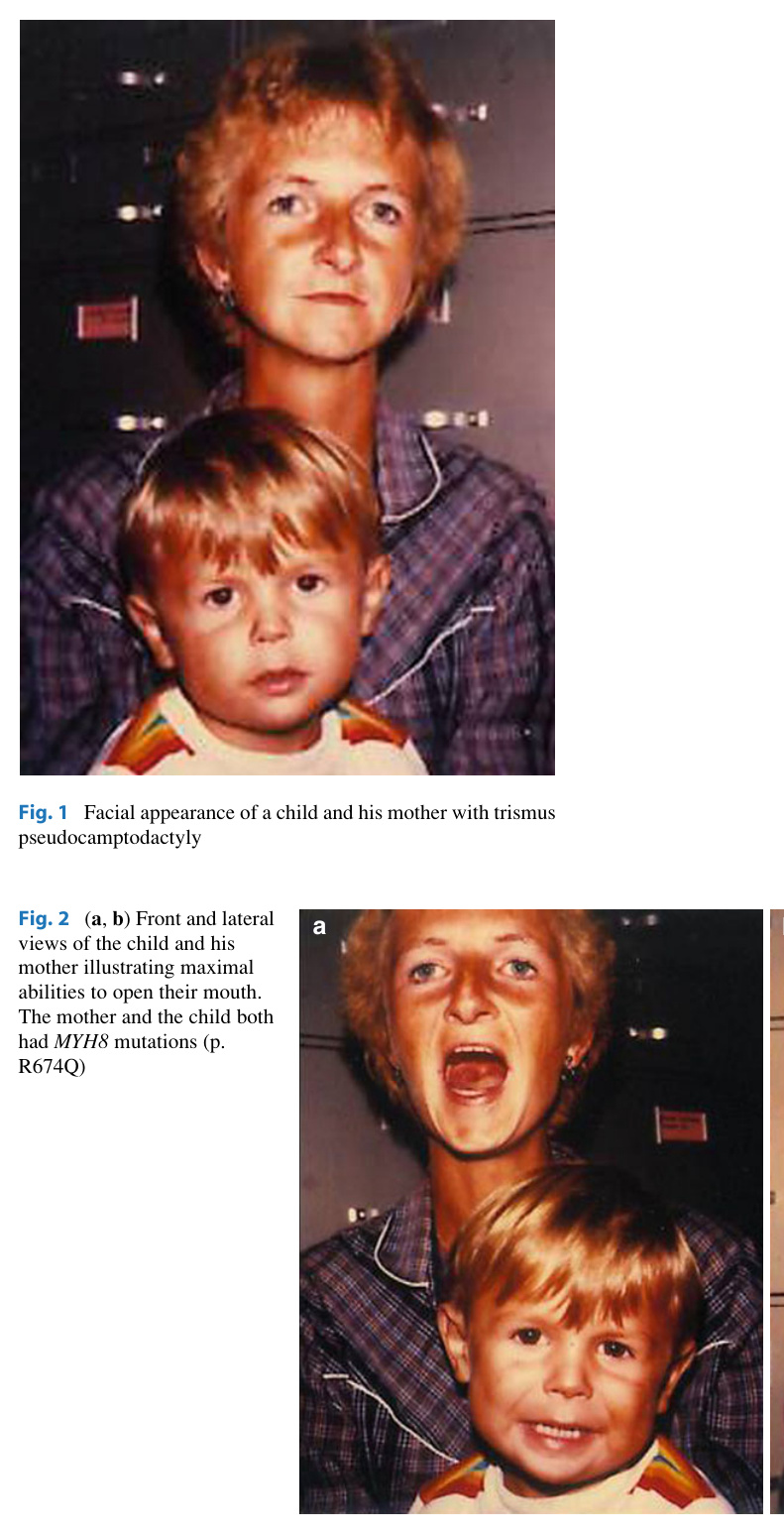
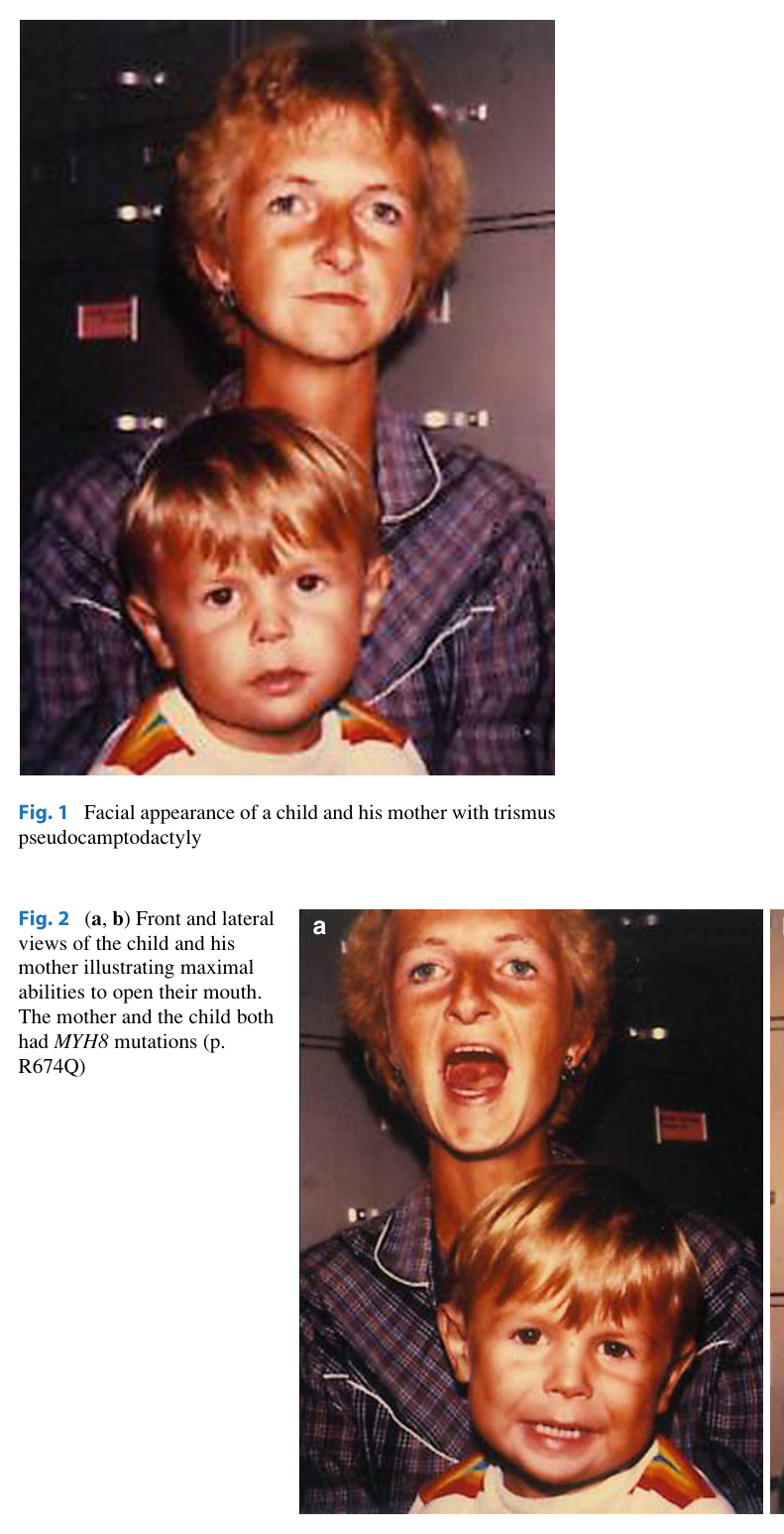
牙关紧闭-假性屈曲指综合征(Trismus-Pseudocamptodactyly Syndrome)是一种相对罕见的遗传性疾病,以不能完全张口(牙关紧闭)、假性屈曲指、轻度足部畸形和轻度身材矮小为特征。该畸形综合征最早由Hecht和Beals以及Wilson等人在1969年报道。Mabry等人创造了“Dutch-Kentucky综合征”这一术语,因为最早受累成员是一名在美国独立战争后不久移民至美国南部的年轻荷兰女孩。该病具有高外显率和可变表现度,由MYH8基因(肌球蛋白重链8)的单一致病突变p.R674Q引起。病理生理机制涉及某些咀嚼肌(颞肌、翼内肌、咬肌)长度缩短、冠突增大、上颌骨与下颌骨之间异常韧带以及咬肌纤维化异常。假性屈曲指由指深屈肌腱单位缩短引起,累及所有手指。足部畸形可由腿和足部各肌腱组缩短解释。远端关节挛缩综合征共享相似发病机制,一般由肌肉收缩复合体破坏所致。
遗传模式与家系特征
常染色体显性遗传,高外显率,可变表现度。患者同胞再发风险除非父母受累(轻度受累父母可能被漏诊)或存在生殖细胞嵌合体,否则不增加;患者子代再发风险为50%。
致病基因与突变谱系
由MYH8基因(肌球蛋白重链8)的单一致病突变p.R674Q(c.2021G>A, p.Arg674Gln)引起。该突变在多个家系中反复出现。生殖细胞嵌合体已有报道(Bonapace等,2010)。
组织病理生理机制与解剖学缺陷
牙关紧闭的可能机制包括:某些咀嚼肌(颞肌、翼内肌、咬肌)长度缩短;冠突增大(由短颞肌腱单位张力所致,撞击颧骨体和弓内缘,从而限制下颌运动);上颌骨与下颌骨之间、咬肌前方异常韧带;升支附近咬肌纤维化异常。假性屈曲指由指深屈肌腱单位缩短引起,累及所有手指;该术语比“屈曲指”更合适,因为不伴有进行性畸形或固定关节挛缩。足部畸形可由腿和足部各肌腱组缩短解释。远端关节挛缩综合征共享相似发病机制,一般由快肌纤维收缩复合体功能异常所致。
权威原著彩色临床图谱库 共 6 套超清图解
原著 200 DPI 高清无损裁切 • 完整保留图面 a, b, c, d 子标识 • 点击图面唤起全屏无损灯箱
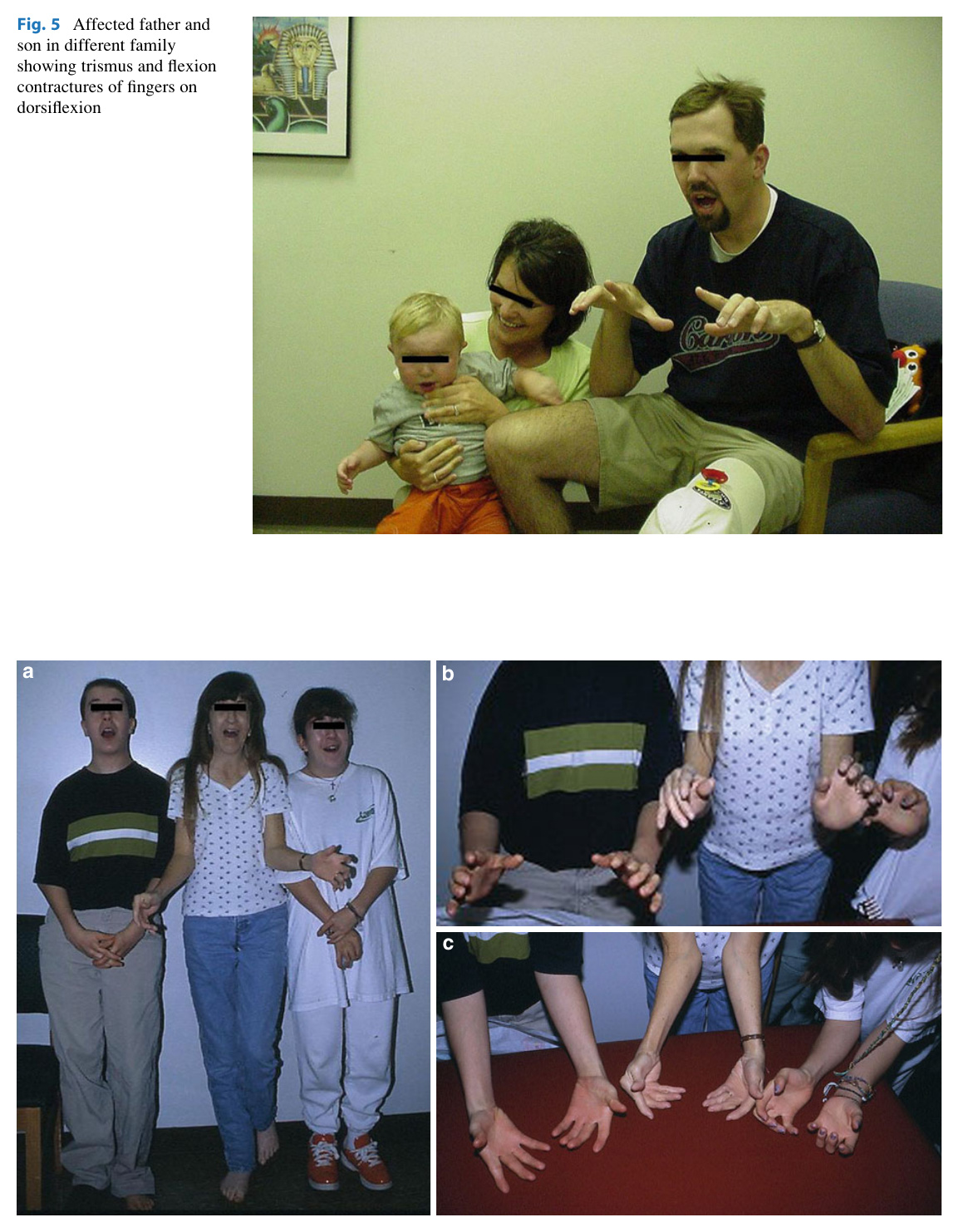
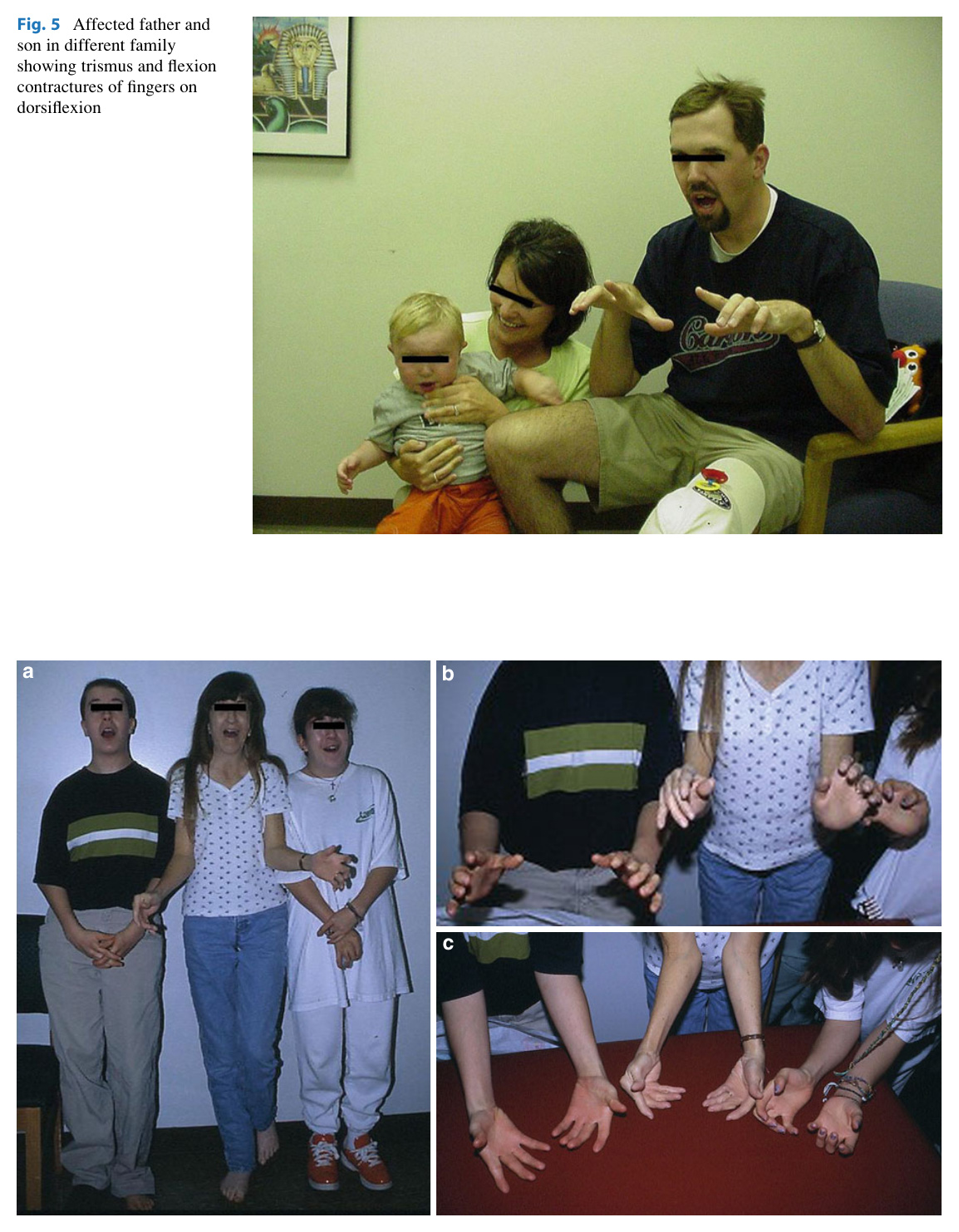
临床表型全貌与自然转归 (Clinical Features)
主要症状、核心体征、严重度分型、各期并发症及长期预后
1. 主要临床症状 (Major Clinical Symptoms)
下颌运动受限(牙关紧闭)
出生时即存在并持续终生。张口受限程度差异极大。张口度测量上、下中切牙切缘之间的距离(毫米)。儿童:低于正常儿童值(7岁时36.6±5.7 mm至18岁时47.2±6.4 mm)。成人:低于正常成人值(男性53.8±6.5 mm,女性50.4±5.9 mm)。
咀嚼问题
因下颌运动受限导致咀嚼困难。
喂养问题
因张口受限导致喂养困难,热量摄入不足。
吞咽困难
吞咽困难(dysphagia)。
牙齿护理困难
因张口受限导致牙齿护理困难。
言语发育延迟
言语发育延迟。
全身麻醉气管插管困难
因张口受限导致全身麻醉时气管内插管困难。
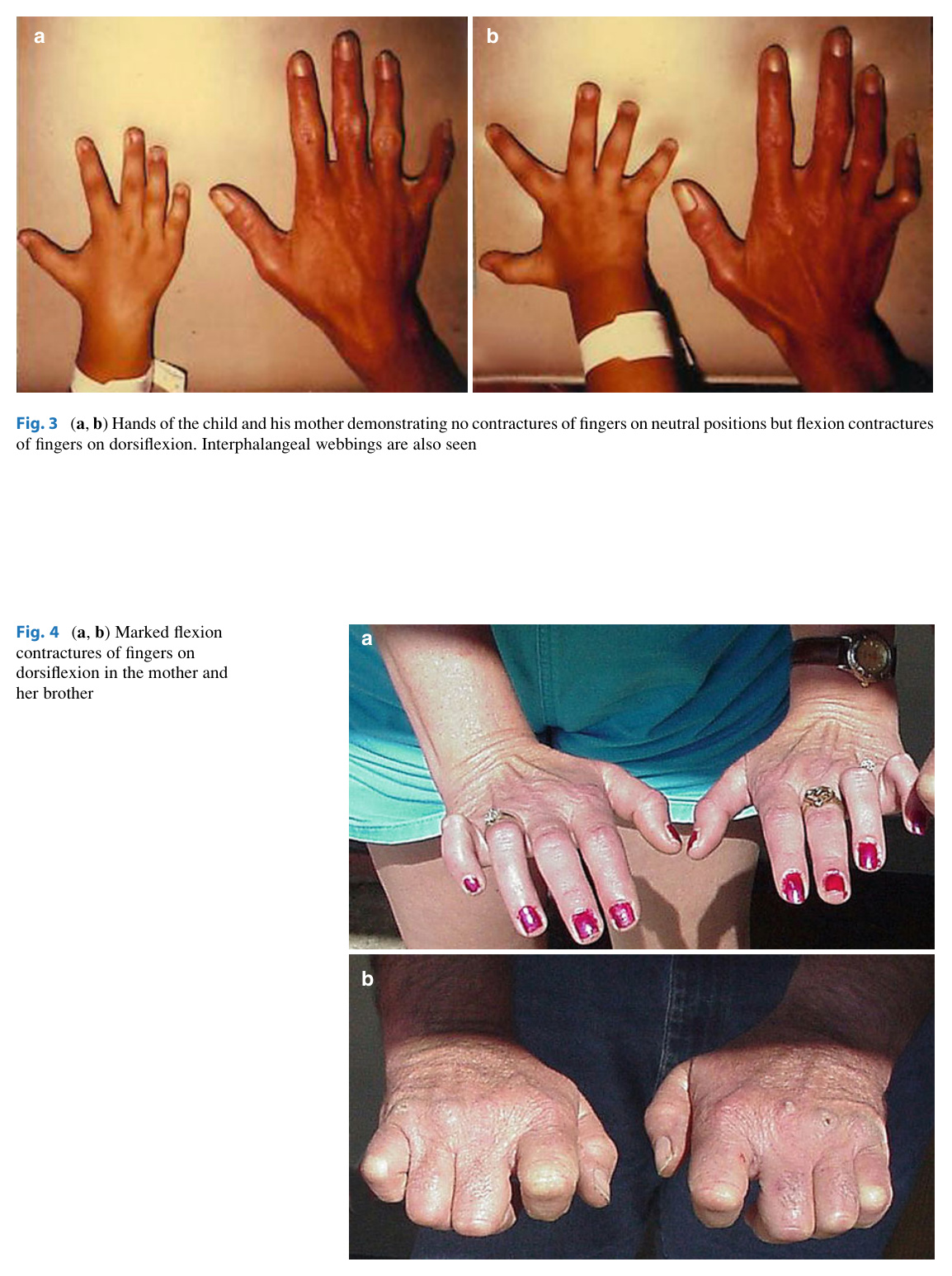
手指屈曲畸形(假性屈曲指)
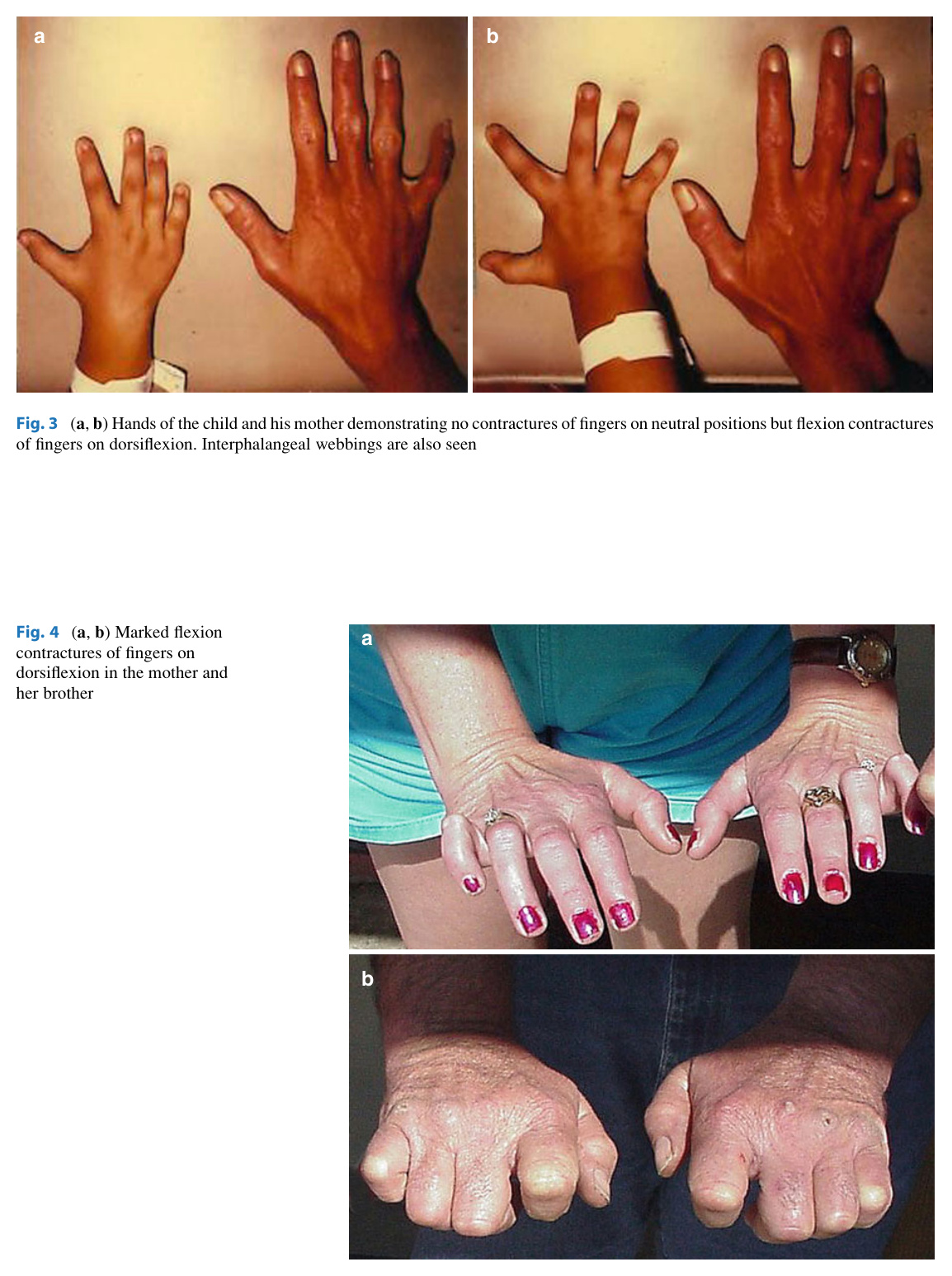
出生时可能存在握拳。婴儿期后期典型表现为用指关节爬行。腕关节伸展时出现手指屈曲(假性屈曲指),腕关节屈曲时逆转。轻度受累患者手背屈时出现手指屈曲;重度受累患者出现明显屈曲伴手指尺偏。
2. 主要体格检查体征 (Major Clinical Signs)
张口受限
牙关紧闭,出生时即存在并持续终生,程度高度可变。测量上、下中切牙切缘间距。
假性屈曲指
腕关节伸展时手指屈曲,腕关节屈曲时逆转。轻度受累患者仅手背屈时出现手指屈曲;重度受累患者出现明显屈曲伴尺偏。
下肢及足部畸形(约5%病例)
轻度跟骨外翻、马蹄内翻足、跖骨内翻、屈曲指、垂直距骨、锤状趾畸形、腓肠肌和腘绳肌缩短。
软组织并指
偶见软组织并指。
轻度身材矮小
轻度矮身材。
3. 并发症与生命安全风险 (Complications / Risks)
- 喂养困难导致热量摄入不足
- 吞咽困难
- 言语发育延迟
- 全身麻醉时气管插管困难或无法进行人工通气和气管内插管,需紧急气管切开和环甲膜切开
- 牙齿护理困难
4. 自然病程、寿命预后与致死性亚型 (Prognosis & Lethal Forms)
- 自然转归:牙关紧闭持续终生,程度可变;假性屈曲指非进行性,不伴固定关节挛缩;轻度身材矮小;智力正常。寿命预后一般良好,但麻醉管理风险需重视。
辅助检查与全解剖部位影像征象 (Diagnostic Investigations)
骨骼放射平片解剖细分、颅颈磁共振MRI、组织病理学及分子诊断流程
放射影像学特征(各解剖部位细分征象 Radiologic Features)
- 冠突增大
- X线平片正常
生长板组织病理学 (Histology / Pathology)
- 受累肌肉组织学显示纤维组织存在并伴部分肌肉萎缩。
分子与细胞遗传学检测策略 (Mutation Analysis)
- MYH8基因突变分析:检测p.R674Q(c.2021G>A, p.Arg674Gln)致病突变。
遗传咨询、再发风险与全生命周期健康监护
生殖腺嵌合体风险量化、产前鉴别生长曲线及 AAP 临床监护规范
再发风险量化评估 (Recurrence Risk Assessment)
- 患者同胞:除非父母受累(轻度受累父母可能被漏诊)或存在生殖细胞嵌合体,否则再发风险不增加。
- 患者子代:50%。
产前筛查、超声鉴别与分子确诊路径 (Prenatal Diagnosis)
产前分子诊断
尚未见报道,但在高危家族中可行:通过羊膜腔穿刺或绒毛膜绒毛取样(CVS)获取胎儿DNA进行MYH8突变分析,前提是已在该家系受累成员中鉴定出致病突变。
临床健康监护与多学科干预方案 (Management & Health Supervision Protocol)
婴儿期喂养
使用扁平奶嘴辅助喂养。
麻醉管理
下颌运动受限;可能难以或无法进行人工通气和气管内插管;小手术推荐吸入麻醉并保留自主呼吸;Bullard喉镜是张口受限患者插管的优良设备;纤维光学鼻气管插管;需准备紧急气管切开和环甲膜切开。
重度牙关紧闭的手术松解
双侧冠突切除术并切除附属纤维组织;双侧肥大冠突切除术;缩短的肌肉-肌腱单位手术松解;术后每日进行下颌开口拉伸的持续物理治疗以避免复发。
手指屈曲畸形手术
前臂屈肌腱行屈肌腱滑行手术(flexor slide-through procedure)。
权威原著参考文献 (References)
Harold Chen 著作全书收录之经典学术文献与循证医学来源
- Bonapace G, Ceravolo F, Piccirillo A, et al. Germline mosaicism for the c.2021G>A (p.Arg674Gln) mutation in siblings with trismus pseudocamptodactyly. Am J Med Genet A. 2010;152A:2898–2900.
- Browder FH, Lew D, Shahbazian TS. Anesthetic management of a patient with Dutch-Kentucky syndrome. Anesthesiology. 1986;65:218–219.
- Chen H, Fowler M, Hogan GR, et al. Trismus-pseudocamptodactyly syndrome: Report of a family and review of literature with special consideration of morphologic features of the muscles. Dysmorphology of Clinical Genetics. 1992;6:165–174.
- Chen H, Hogan GR, Fowler M, et al. Trismus-pseudocamptodactyly syndrome: Morphologic studies of muscle. Am J Med Genet. 1986;25:736–737.
- DeJong JGY. A family showing strongly reduced ability to open the mouth and limitation of some movements of the extremities. Humangenetik. 1971;13:210–217.
- Gasparini G, Boniello R, Moro A, et al. Trismus-pseudocamptodactyly syndrome. Case report ten years after. Eur J Paediatr Dent. 2008;9:199–203.
- Hall JG, Reed SD, Green A. The distal arthrogryposis: Delineation of new entities. Review and nosologic discussion. Am J Med Genet. 1982;11:185–239.
- Hecht F, Beals RK. Inability to open the mouth fully: An autosomal dominant phenotype with facultative camptodactyly and short stature. Preliminary note. Birth Defects Orig Artic Ser. 1969;5(3):96–98.
- Hertrich K, Schuch H. Restricted mouth opening as a leading symptom of trismus-pseudocamptodactyly syndrome. Dtsch Zahnarztl Z. 1991;46:416–419.
- Horowitz SL, McNutty EC, Chabora AJ. Limited intermaxillary opening, an inherited trait. Oral Surg. 1973;36:490–492.
- Lano CF, Werkhaven J. Airway management in a patient with Hecht's syndrome. South Med J. 1997;90:1241–1243.
- Lefaivre JF, Aitchison MJ. Surgical correction of trismus in a child with Hecht syndrome. Ann Plast Surg. 2003;50:310–314.
- Mabry CC, Barnett IS, Hutcheson MW, et al. Trismus pseudocamptodactyly syndrome. Dutch-Kentucky syndrome. J Pediatr. 1974;85:503–508.
- Markus AF. Limited mouth opening and shortened flexor muscle-tendon units: Trismus-pseudocamptodactyly syndrome. Br J Oral Maxillofac Surg. 1986;24:137–142.
- Mercuri LG. The Hecht, Beals and Wilson syndrome. J Oral Maxillofac Surg. 1981;39:53–56.
- Minzer-Conzetti K, Wu E, Vargervik K, et al. Phenotypic variation in trismus-pseudocamptodactyly syndrome caused by a recurrent MYH8 mutation. Clin Dysmorphol. 2008;17:1–4.
- O'Brien PJ, Gropper PT, Tredwell SJ, et al. Orthopaedic aspects of the trismus pseudocamptodactyly syndrome. J Pediatr Orthop. 1984;4:469–471.
- Robertson RD, Spence MA, Sparkes RS, et al. Linkage analysis with the trismus-pseudocamptodactyly syndrome. Am J Med Genet. 1982;12:115–120.
- Seavello J, Hammer GB. Tracheal intubation in a child with trismus pseudocamptodactyly (Hecht) syndrome. J Clin Anesth. 1999;11:254–256.
- Ter Haar BGA, Van Hoof RF. The trismus-pseudocamptodactyly syndrome. J Med Genet. 1974;11:41–49.
- Toydemir RM, Chen H, Proud VK, et al. Trismus-pseudocamptodactyly syndrome is caused by recurrent mutation of MYH8. Am J Med Genet A. 2006a;140A:2387–2393.
- Toydemir RM, Rutherford A, Whitby FG, et al. Mutations in embryonic myosin heavy chain (MYH8) cause Freeman-Sheldon syndrome and Sheldon-Hall syndrome. Nat Genet. 2006b;38:561–565.
- Tsukahara M, Shinozaki F, Kajii T. Trismus-pseudocamptodactyly syndrome in a Japanese family. Clin Genet. 1985;28:247–250.
- Vaghadia H, Blackstock D. Anaesthetic implications of the trismus pseudocamptodactyly syndrome (Dutch-Kentucky or Hecht-Beals) syndrome. Can J Anaesth. 1988;35:80–85.
- Veugelers M, Bressan M, McDermott DA, et al. Mutation of perinatal myosin heavy chain associated with a Carney complex variant. N Engl J Med. 2004;351:460–469.
- Wilson RV, Gaines DL, Brooks A, et al. Autosomal dominant inheritance of shortening of the flexor profundus muscle-tendon unit with limitation of jaw excursion. Birth Defects Orig Artic Ser. 1969;5(3):99–102.
- Yamashita DDR, Amet GF. Trismus-pseudocamptodactyly syndrome. J Oral Surg. 1980;38:625–630.