尺骨-乳腺综合征
(Ulnar-Mammary Syndrome) 骨骼与结缔组织遗传病 OMIM: 181450 全本详注版| 致病基因 / 机制 | 染色体定位 | 遗传方式 | 发病率估计 |
|---|---|---|---|
| TBX3 | 12q23-q24.1 | 常染色体显性遗传 | 尚无确切发病率数据,为罕见遗传病 |
疾病概述与分子发病机理 (Genetics & Basic Defects)
流行病学数据、致病突变位点、信号转导通路及组织病理生理学
流行病学与全篇概述
尺骨-乳腺综合征(Ulnar-Mammary Syndrome, UMS)最早由Gilly于1882年描述,患者为一名女性,表现为乳腺发育不全、无法泌乳以及第3至第5指及尺骨缺失。1978年Pallister等报道了一名年轻女性的复杂畸形综合征,涉及尺侧列、前臂、乳腺组织、腋窝大汗腺、牙齿、腭、脊柱及泌尿生殖系统的异常发育。本病是一种多效性障碍,影响肢体、大汗腺、牙齿、毛发及生殖器发育。遗传方式为常染色体显性遗传,表现度可变。致病基因为TBX3,定位于染色体12q23-q24.1,其编码的T-box转录因子DNA结合域被突变破坏。人类TBX3突变可改变肢体、大汗腺及生殖器发育。错义突变与缺失/移码突变之间未见明显表型差异。
遗传模式与家系特征
常染色体显性遗传,表现度可变。患者同胞再发风险除非父母一方患病否则不增加;患者子代再发风险为50%。
致病基因与突变谱系
致病基因为TBX3(T-box基因家族),定位于12q23-q24.1。突变类型包括:错义突变(L143P、Y149S);无义突变(Q360TER、S343TER);剪接位点突变(IVS2+1G>C、IVS6+2T>A),产生截短蛋白产物;小片段重复导致的移码突变。错义突变与缺失/移码突变之间未见明显表型差异。
组织病理生理机制与解剖学缺陷
TBX3编码一种T-box转录因子,其DNA结合域被突变破坏后影响肢体、大汗腺及生殖器发育。TBX3是p19ARF的负调控因子,抑制细胞衰老;Tbx3中的显性抑制域介导转录抑制和细胞永生化。Tbx3缺失小鼠表现乳腺、肢体及卵黄囊缺陷。
权威原著彩色临床图谱库 共 1 套超清图解
原著 200 DPI 高清无损裁切 • 完整保留图面 a, b, c, d 子标识 • 点击图面唤起全屏无损灯箱
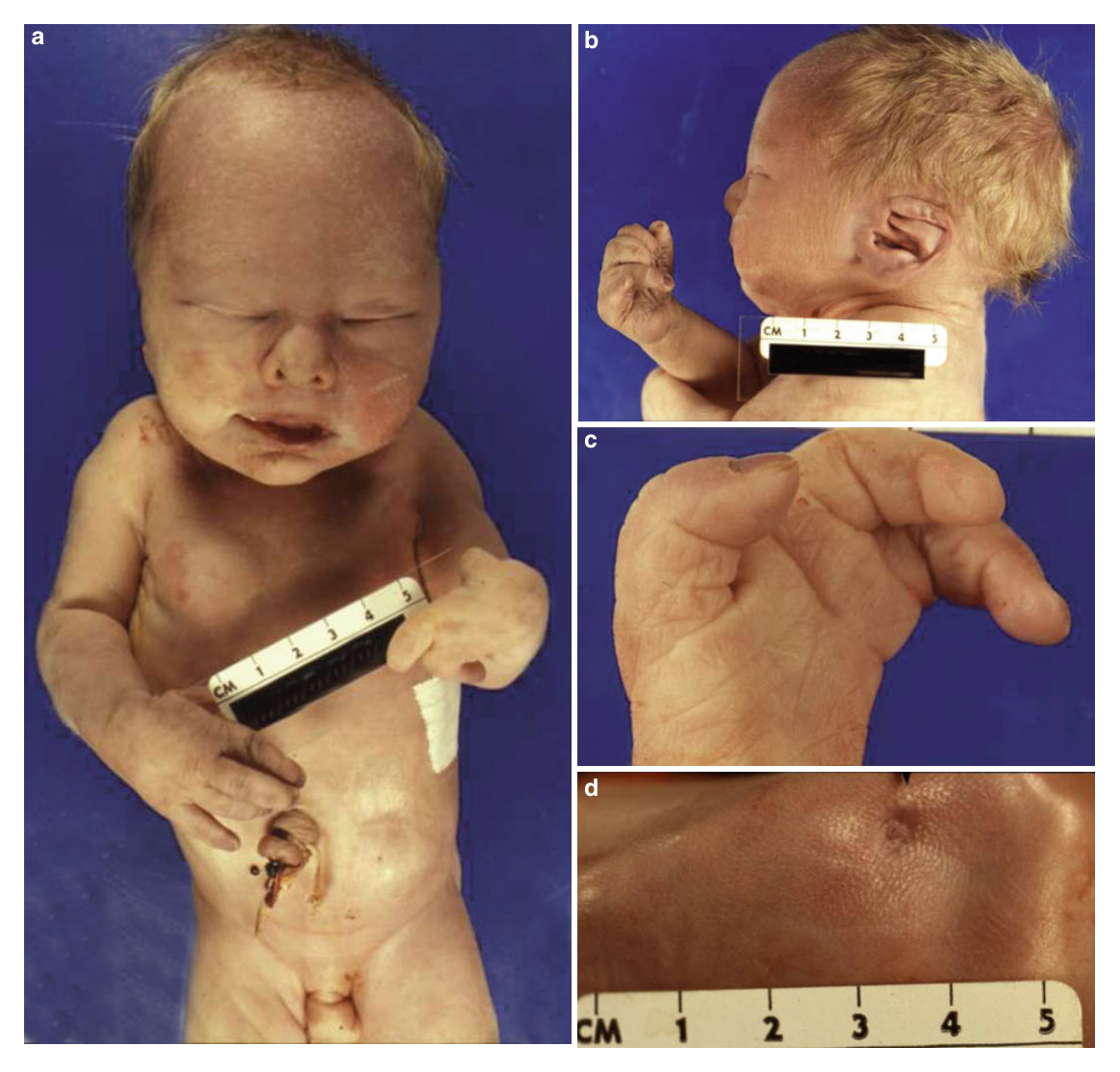
临床表型全貌与自然转归 (Clinical Features)
主要症状、核心体征、严重度分型、各期并发症及长期预后
1. 主要临床症状 (Major Clinical Symptoms)
后肢(上肢)缺陷
表现广泛可变。大多数患者存在尺侧列缺陷:第五指末节指骨发育不全;尺骨及第3、4、5指发育不全或完全缺失。可见轴后性多指(趾)、屈曲指(camptodactyly)、指(趾)融合。
大汗腺异常
乳腺异常表现可变:乳腺发育不全至再生障碍、乳头发育不全;副乳头;无法母乳喂养;部分患者乳腺发育及泌乳正常。出汗能力下降;体味减轻;腋窝无汗;腋毛稀疏。
生殖器异常(性腺发育不全)
男性患者:青春期延迟、腋毛减少至缺失、小阴茎、隐睾、小睾丸、阴囊呈披肩状(shawl scrotum)、生育力下降。女性患者:腋毛减少至缺失、部分患者处女膜闭锁。
牙齿异常
牙齿错位、牙齿缺失、少牙畸形(hypodontia)。
其他异常
青春期延迟、身材矮小、肥胖、外侧眉毛稀疏、声门下狭窄、幽门狭窄、肾缺如/肾畸形、肺发育不全、腹股沟疝、肛门闭锁/狭窄。肌肉骨骼异常:前臂短、肱骨/肩胛骨/锁骨发育不全、胸大肌发育不全、第4至第5趾末节趾骨短、僵硬且弯曲。
2. 主要体格检查体征 (Major Clinical Signs)
肢体体征
尺侧列缺陷:第五指末节指骨发育不全,尺骨及第3、4、5指发育不全或完全缺失;轴后性多指;屈曲指;指融合。前臂短;肱骨、肩胛骨、锁骨发育不全;胸大肌发育不全;第4至第5趾短、僵硬、弯曲。
乳腺及大汗腺体征
乳腺发育不全至再生障碍,乳头发育不全;副乳头;腋毛稀疏;腋窝无汗;体味减轻;出汗能力下降。
生殖器体征
男性:小阴茎、隐睾、小睾丸、阴囊呈披肩状。女性:处女膜闭锁(部分)。
其他体征
身材矮小、肥胖、外侧眉毛稀疏、牙齿错位/缺失/少牙。
3. 并发症与生命安全风险 (Complications / Risks)
- 声门下狭窄可导致气道梗阻
- 幽门狭窄可导致喂养困难及呕吐
- 肛门闭锁/狭窄需外科干预
- 肾缺如/肾畸形可导致肾功能不全
- 肺发育不全可导致呼吸窘迫
- 隐睾增加睾丸肿瘤风险及不育风险
- 男性性腺功能减退导致青春期延迟及生育力下降
- 女性处女膜闭锁可导致经血潴留
4. 自然病程、寿命预后与致死性亚型 (Prognosis & Lethal Forms)
- 自然转归取决于畸形严重程度,多数患者寿命正常,但严重肺发育不全、肾畸形或声门下狭窄可危及生命
- 智力发育通常正常
- 生育力可能下降,尤其男性患者
- 需多学科长期随访管理
辅助检查与全解剖部位影像征象 (Diagnostic Investigations)
骨骼放射平片解剖细分、颅颈磁共振MRI、组织病理学及分子诊断流程
放射影像学特征(各解剖部位细分征象 Radiologic Features)
- 第五指短且僵硬
- 第五指列缺失
- 第四指列缺失
- 第四至第五指列缺失
- 第三至第五指列缺失
- 屈曲指
- 轴后性多指
- 尺骨发育不全/缺失/变形
- 桡骨发育不全/缺失/变形
- 肱骨、肩胛骨、锁骨发育不全
- 胸大肌发育不全
- 剑突缺失
- 第4、5趾短且僵硬
分子与细胞遗传学检测策略 (Mutation Analysis)
- TBX3基因突变分析:错义突变(L143P、Y149S)、无义突变(Q360TER、S343TER)、剪接位点突变(IVS2+1G>C、IVS6+2T>A)、小片段重复导致的移码突变
- 对羊水细胞及绒毛膜绒毛取样(CVS)进行突变分析,适用于已明确致病突变的家庭
遗传咨询、再发风险与全生命周期健康监护
生殖腺嵌合体风险量化、产前鉴别生长曲线及 AAP 临床监护规范
再发风险量化评估 (Recurrence Risk Assessment)
- 患者同胞再发风险:除非父母一方患病,否则不增加
- 患者子代再发风险:50%
产前筛查、超声鉴别与分子确诊路径 (Prenatal Diagnosis)
超声检查及胎儿镜检查
对存在风险的妊娠,若胎儿出现明显骨骼异常可进行产前诊断
羊水细胞及绒毛膜绒毛取样(CVS)突变分析
适用于已明确致病突变的家庭
临床健康监护与多学科干预方案 (Management & Health Supervision Protocol)
骨科管理
肢体缺陷的骨科矫治与康复
泌尿外科管理
隐睾行睾丸固定术(orchiopexy)
内分泌管理
男性性腺功能减退者行睾酮替代治疗
喂养管理
母亲乳头发育不全或缺失时,婴儿采用奶瓶喂养
多学科随访
针对声门下狭窄、幽门狭窄、肛门闭锁、肾畸形、肺发育不全等并发症进行相应专科评估与干预
权威原著参考文献 (References)
Harold Chen 著作全书收录之经典学术文献与循证医学来源
- Bamshad M, Krakowiak PA, Watkins WS, et al. A gene for ulnar-mammary syndrome maps to 12q23-q24.1. Human Molecular Genetics. 1995;4:1973–1977.
- Bamshad M, Le T, Watkins WS, et al. The spectrum of mutations in TBX3: Genotype/Phenotype relationship in ulnar-mammary syndrome. American Journal of Human Genetics. 1999;64:1550–1562.
- Bamshad M, Lin RC, Law DJ, et al. Mutations in human TBX3 alter limb, apocrine and genital development in ulnar-mammary syndrome. Nature Genetics. 1997;16:311–315.
- Bamshad M, Root S, Carey JC. Clinical analysis of a large kindred with the Pallister ulnar-mammary syndrome. American Journal of Medical Genetics. 1996;65:325–331.
- Brummelkamp TR, Kortlever RM, Lingbeek M, et al. TBX-3, the gene mutated in Ulnar-Mammary Syndrome, is a negative regulator of p19ARF and inhibits senescence. Journal of Biological Chemistry. 2002;277:6567–6572.
- Carlson H, Ota S, Campbell CE, et al. A dominant repression domain in Tbx3 mediates transcriptional repression and cell immortalization: Relevance to mutations in Tbx3 that cause ulnar-mammary syndrome. Human Molecular Genetics. 2001;10:2403–2413.
- Coll M, Seidman JG, Muller CW. Structure of the DNA-bound T-box domain of human TBX3, a transcription factor responsible for ulnar-mammary syndrome. Structure (Cambridge). 2002;10:343–356.
- Davenport TG, Jerome-Majewska LA, Papaioannou VE. Mammary gland, limb and yolk sac defects in mice lacking Tbx3, the gene mutated in human ulnar mammary syndrome. Development. 2003;130:2263–2273.
- Edwards MJ, McDonald D, Moore P, et al. Scalp-ear-nipple syndrome: Additional manifestations. American Journal of Medical Genetics. 1994;50:247–250.
- Franceschini P, Vardeu MP, Dalforno L, et al. Possible relationship between ulnar-mammary syndrome and split hand with aplasia of the ulna syndrome. American Journal of Medical Genetics. 1992;44:807–812.
- Froster GU, Baird PA. Upper limb deficiencies and associated malformations: A population-based study. American Journal of Medical Genetics. 1992;44:767–781.
- Gilly E. Absence complète des mamelles chez une femme mère: Atrophie du member supérieur droit. Courrier Medicine. 1882;32:27–28.
- Gonzalez CH, Herrmann J, Opitz JM. Studies of malformation syndromes of man XXXXIIB: Mother and son affected with the ulnar-mammary syndrome type Pallister. European Journal of Pediatrics. 1976;123:225–235.
- He M, Wen L, Campbell CE, et al. Transcription repression by Xenopus ET and its human ortholog TBX3, a gene involved in ulnar-mammary syndrome. Proceedings of the National Academy of Sciences of the United States of America. 1999;96:10212–10217.
- Hecht JT, Scott CI. The Schinzel syndrome in a mother and daughter. Clinical Genetics. 1984;25:63–67.
- Pallister PD, Hermann J, Opitz JM. Studies of Malformation Syndromes in Man XXXXII: A pleiotropic dominant mutation affecting skeletal, sexual and apocrine-mammary development. Birth Defects Original Article Series. 1976;XII(5):247–254.
- Rogers C, Anderson G. Hand-foot-uterus syndrome vs. ulnar-mammary syndrome in a patient with overlapping phenotypic features. Proceedings of the Greenwood Genetic Center. 1995;14:17–20.
- Sasaki G, Ogata T, Ishii T, et al. Novel mutation of TBX3 in a Japanese family with ulnar-mammary syndrome: Implication for impaired sex development. American Journal of Medical Genetics. 2002;110:365–369.
- Schinzel A. Ulnar-mammary syndrome. Journal of Medical Genetics. 1987;24:778–781.
- Schinzel A, Illig R, Prader A. The ulnar-mammary syndrome: An autosomal dominant pleiotropic gene. Clinical Genetics. 1987;32:160–168.
- Sherman J, Angulo MA, Sharp A. Mother and infant son with ulnar-mammary syndrome of Pallister plus additional findings. American Journal of Human Genetics. 1986;39:A82.
- van Bokhoven H, Jung M, Smits AP, et al. Limb mammary syndrome: A new genetic disorder with mammary hypoplasia, ectrodactyly, and other hand/foot anomalies maps to human chromosome 3q27. American Journal of Human Genetics. 1999;64:538–546.
- Wollnik B, Kayserili H, Uyguner O, et al. Haploinsufficiency of TBX3 causes ulnar-mammary syndrome in a large Turkish family. Annales de Genetique. 2002;45:213–217.