49,XXXXY综合征
(XXXXY Syndrome) 染色体异常综合征 全本详注版| 致病基因 / 机制 | 染色体定位 | 遗传方式 | 发病率估计 |
|---|---|---|---|
| 无特定单一致病基因(染色体非整倍体) | X染色体四体(49,XXXXY) | 散发性染色体异常(非孟德尔遗传) | 约1/85,000新生男婴 |
疾病概述与分子发病机理 (Genetics & Basic Defects)
流行病学数据、致病突变位点、信号转导通路及组织病理生理学
流行病学与全篇概述
49,XXXXY综合征由Fraccaro和Lindsten于1960年首次描述,是一种罕见的性染色体非整倍体疾病,核型为49,XXXXY。发病率约为1/85,000新生男婴(Pallister 1982)。该综合征以智力障碍、桡尺骨骨性连接(radioulnar synostosis)和性腺功能减退(hypogonadism)组成的“经典三联征”为特征,同时伴有生长迟缓、严重语言障碍、颅面畸形、先天性心脏缺陷、骨骼异常及生殖器发育不良等多系统表现。额外X染色体的数量与表型异常及智力障碍的严重程度呈直接正相关,每增加一条额外X染色体,严重程度递增。该病为散发性,再发风险极低,患者因不育而无后代。
遗传模式与家系特征
本病为散发性染色体非整倍体异常,非孟德尔遗传。患者父母核型通常正常,再发风险不增加。患者因性腺功能减退及不育而无后代,故无垂直传递可能。
致病基因与突变谱系
无特定单一致病基因。核型为49,XXXXY,即男性拥有四条X染色体和一条Y染色体。四条X染色体均来源于母亲。
组织病理生理机制与解剖学缺陷
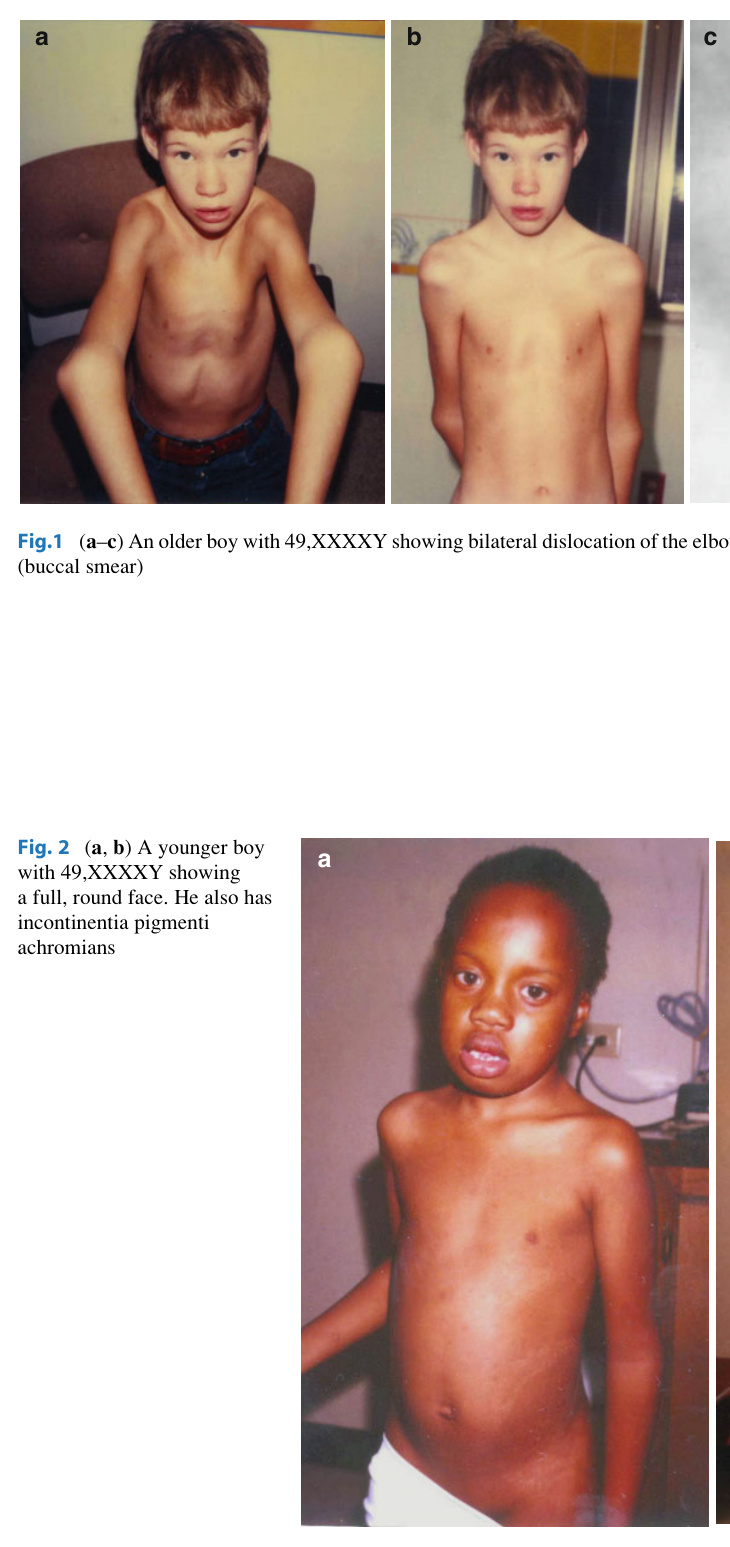
发病机制为母亲减数分裂I和II连续发生不分离(successive nondisjunctions),形成含四条X染色体的卵子,与正常含Y染色体的精子受精后形成49,XXXXY核型(Deng et al. 1991)。根据Lyon假说,四条X染色体中三条失活,仅一条保持活性,因此在颊黏膜涂片(buccal smear)中可观察到三个Barr小体(Barr bodies)。额外X染色体数量与表型异常及智力障碍的严重程度呈直接正相关:体细胞发育(尤其是骨骼和心血管系统)受显著影响;男性性腺发育对额外遗传物质尤为敏感,47,XXY(Klinefelter综合征)即可导致生精小管发育不良(seminiferous tubal dysgenesis)而不育,而48,XXXY和49,XXXXY等多X男性不仅不育,还可出现生殖器发育不良和畸形;认知发育亦受累,表现为严重智力障碍、语言延迟(表达性和接受性语言均受累)及行为问题。
权威原著彩色临床图谱库 共 2 套超清图解
原著 200 DPI 高清无损裁切 • 完整保留图面 a, b, c, d 子标识 • 点击图面唤起全屏无损灯箱
临床表型全貌与自然转归 (Clinical Features)
主要症状、核心体征、严重度分型、各期并发症及长期预后
1. 主要临床症状 (Major Clinical Symptoms)
智力障碍
不同程度的智力障碍,通常为严重智力障碍,为经典三联征之一。
语言障碍
严重语言损害,表达性语言和接受性语言均延迟。
生长迟缓
生长迟缓,身材矮小。
行为问题
行为问题,包括胆小害羞、情绪障碍伴挫折耐受阈值低、对微小变化反应强烈;适应功能高于认知功能。
发育性运用障碍
中度至重度发育性运用障碍(developmental dyspraxia),同时可见先前未被认识的非语言技能保留。
2. 主要体格检查体征 (Major Clinical Signs)
颅面体征
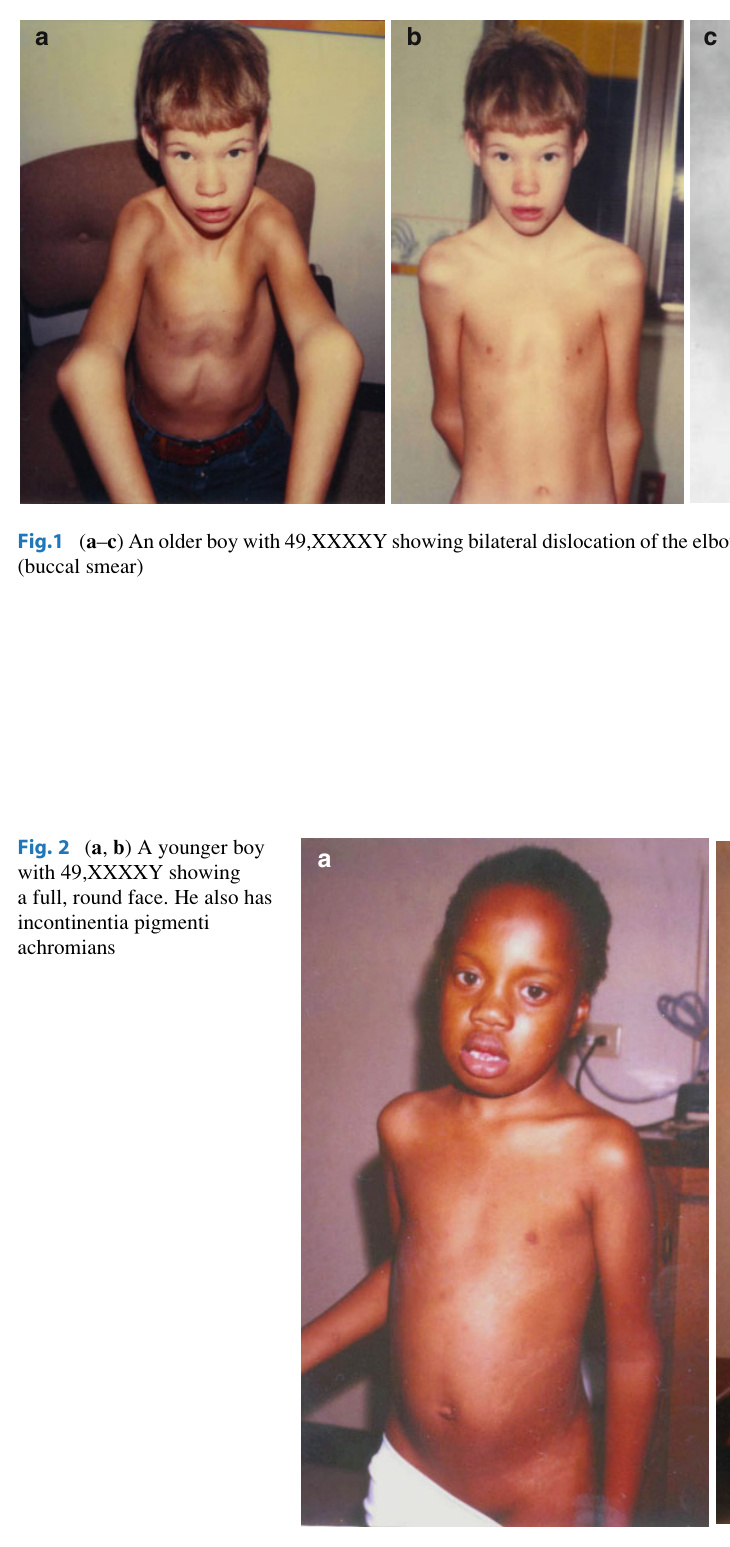
小头畸形(microcephaly)、饱满圆脸、眼距过宽(ocular hypertelorism)、睑裂上斜(upslanted palpebral fissures)、内眦赘皮(epicanthus)、鼻梁宽、小颌畸形(micrognathia)、下颌前突(prognathism)、高腭弓或腭裂、牙齿排列不齐、耳畸形。
颈部体征
蹼颈和短颈。
先天性心脏缺陷
动脉导管未闭(patent ductus arteriosus)、房间隔缺损(atrial septal defect)、肺动脉狭窄(pulmonic stenosis)、法洛四联症(Tetralogy of Fallot)。
骨骼异常
身材矮小、近端桡尺骨骨性连接(proximal radioulnar synostosis)、近端胫腓骨骨性连接(proximal tibiofibular synostosis,Nishimura et al. 2008)、椎体异常、第五指弯曲指(clinodactyly of the fifth fingers)、髋外翻(coxa valga)、膝外翻(genu valgum)、扁平足(pes planus)。
生殖器异常
男性生殖器发育不良、小阴茎(micropenis)、尿道下裂(hypospadias)、小睾丸、性腺功能减退(hypogonadism)、不育。
皮纹学特征
总指嵴计数减少、掌横纹(transverse palmar creases)。
心理特征
胆小害羞、情绪障碍伴挫折耐受阈值低、对微小变化反应强烈、适应功能高于认知功能。
3. 并发症与生命安全风险 (Complications / Risks)
- 严重智力障碍
- 不育
- 先天性心脏缺陷相关血流动力学并发症
- 骨骼畸形导致的功能受限
- 语言及沟通障碍
- 行为及情绪障碍
4. 自然病程、寿命预后与致死性亚型 (Prognosis & Lethal Forms)
- 自然转归:患者因性腺功能减退而不育,无后代。
- 寿命预后:文献未明确提供具体寿命数据,但多系统受累可能影响生活质量及长期健康。
- 临床和认知功能存在变异性,可能反映偏斜X失活(skewed X inactivation)、嵌合体(mosaicism)或其他因素,值得进一步研究(Gropman et al. 2010)。
辅助检查与全解剖部位影像征象 (Diagnostic Investigations)
骨骼放射平片解剖细分、颅颈磁共振MRI、组织病理学及分子诊断流程
放射影像学特征(各解剖部位细分征象 Radiologic Features)
- 近端桡尺骨骨发育不良(proximal radioulnar dysostosis)
- 桡尺骨脱位不伴骨性连接(radioulnar dislocation without synostosis)
- 桡骨上段延长(elongated upper radius)
- 尺骨近端宽大呈杵状(wide, club-shaped proximal ulna)
- 尺骨远端延长(elongated distal ulna)
- 假骨骺(pseudoepiphyses)
- 第五指弯曲指(clinodactyly of the fifth fingers)
- 第五指中节指骨短小(brachymesophalangia V)
- 骨龄延迟(retarded bone age)
- 头状骨角状缺损(corner defect in capitate)
- 第五掌骨塑形不良(poor modeling of the fifth metacarpals)
- 髋外翻(coxa valga)
- 髂骨翼狭窄(narrow iliac wings)
- 髁间窝浅(shallow intercondylar fossa)
- 膝外翻(genu valgum)
- 第一、二趾间间隙增宽(gap between the first and second toes)
- 大趾远端趾骨短宽(short wide distal phalanx of the great toes)
- 颅缝硬化(sclerotic cranial sutures)
- 颅顶增厚(thick cranial vault)
- 眼距过宽(ocular hypertelorism)
- J形蝶鞍(J-shaped sella)
- 下颌前突(prognathism)
- 脊柱侧弯(scoliosis)
- 胸椎后凸(thoracic kyphosis)
- 方形椎体(square vertebral bodies)
- 胸骨增厚(thick)
- 胸骨分节异常(abnormal segmentation)
颅脑与颅颈交界区 MRI (Craniocervical MRI)
- 不同程度脑体积丢失(varying degree of brain volume loss)
- 白质异常(abnormalities in white matter)
生长板组织病理学 (Histology / Pathology)
- 睾丸活检组织学:睾丸生殖细胞及生精小管发育不良(dysgenesis of testicular germ cells and tubules),导致纤维化(fibrosis)。
分子与细胞遗传学检测策略 (Mutation Analysis)
- 染色体核型分析显示49,XXXXY
- 颊黏膜涂片显示三个Barr小体
- FISH使用DNA探针(DXZ1)应用于未培养羊水细胞用于产前诊断
遗传咨询、再发风险与全生命周期健康监护
生殖腺嵌合体风险量化、产前鉴别生长曲线及 AAP 临床监护规范
再发风险量化评估 (Recurrence Risk Assessment)
- 患者同胞再发风险不增加。
- 患者后代:因本病导致不育,无后代。
产前筛查、超声鉴别与分子确诊路径 (Prenatal Diagnosis)
超声标志物
羊水过多(polyhydramnios)、囊性水瘤(cystic hygroma)、马蹄内翻足(clubfoot)、小阴茎(micropenis)。
羊膜腔穿刺和绒毛膜绒毛取样(CVS)
进行染色体核型分析;使用DNA探针(DXZ1)对未培养羊水细胞进行FISH检测。
临床健康监护与多学科干预方案 (Management & Health Supervision Protocol)
早期干预和刺激项目
语言/言语治疗、物理/作业治疗。
睾酮替代治疗
针对性腺功能减退进行睾酮替代治疗。
权威原著参考文献 (References)
Harold Chen 著作全书收录之经典学术文献与循证医学来源
- Chen, C.-P., Chern, S.-R., Chang, C.-L., et al. (2000). Prenatal diagnosis and genetic analysis of X chromosome polysomy 49,XXXXY. Prenatal Diagnosis, 20, 754–757.
- Curfs, L. M., Schreppers-Tijdink, G., Wiegers, A., et al. (1990). The 49,XXXXY syndrome: Clinical and psychological findings in five patients. Journal of Mental Deficiency Research, 34, 277–282.
- Deng, H. X., Abe, K., Kondo, I., et al. (1991). Parental origin and mechanism of formation of polysomy X: An XXXXX case and four XXXXY cases determined with RFLPs. Human Genetics, 86, 541–544.
- Galasso, C., Arpino, C., Fabbri, F., et al. (2003). Neurologic aspects of 49,XXXXY syndrome. Journal of Child Neurology, 18, 501–504.
- Gropman, A. L., Rogol, A., Fennoy, I., et al. (2010). Clinical variability and novel neurodevelopmental findings in 49,XXXXY syndrome. American Journal of Medical Genetics. Part A, 152A, 1523–1530.
- Hecht, F. (1982). Observations on the natural history of 49,XXXXY individuals. American Journal of Medical Genetics, 13, 335–336.
- Hoffman, T. L., Vossough, A., Ficicioglu, C., et al. (2008). Brain magnetic resonance imaging findings in 49,XXXXY syndrome. Pediatric Neurology, 38, 450–453.
- Houston, C. S. (1967). Roentgen findings in the XXXXY chromosome anomaly. Journal of the Canadian Association of Radiologists, 18, 258–267.
- Karsh, R. B. (1975). Congenital heart disease in 49,XXXXY syndrome. Pediatrics, 56, 462–464.
- Kleczkowska, A., Fryns, J.-P., & Van den Berghe, H. (1988). X-chromosome polysomy in the male The Leuven experience 1966–1967. Human Genetics, 80(1), 16–22.
- Kojima, Y., Hayashi, Y., Maruyama, T., et al. (1999). 49,XXXXY syndrome with hydronephrosis caused by intravesical ureterocele. Urologia Internationalis, 63, 212–214.
- Leal, C. A., Belmont, J. W., Nachtman, R., et al. (1994). parental origin of the extra chromosomes in polysomy X. Human Genetics, 94, 423–426.
- Linden, M. G., Bender, B. G., & Robinson, A. (1995). Sex chromosome tetrasomy and pentasomy. Pediatrics, 96, 672–682.
- Lomelino, C. A., & Reiss, A. L. (1991). 49,XXXXY syndrome: Behavioural and developmental profiles. Journal of Medical Genetics, 28, 609–612.
- Nishimura, T., Nii, E., Urawa, M., et al. (2008). Proximal tibiofibular synostosis with 49,XXXXY syndrome, a rare congenital bone anomaly. Journal of Orthopaedic Science, 13, 390–395.
- Pallister, P. D. (1982). 49,XXXXY syndrome. American Journal of Medical Genetics, 13, 337–339.
- Peet, J., Weaver, D. D., & Vance, G. H. (1998). 49,XXXXY: A distinct phenotype. Three new cases and review. Journal of Medical Genetics, 35, 420–424.
- Rehder, H., Fraccaro, M., Cuoco, C., et al. (1986). The fetal pathology of the XXXXY-syndrome. Clinical Genetics, 30, 213–218.
- Schluth, C., Doray, B., Girard-Lemaire, F., et al. (2002). Prenatal sonographic diagnosis of the 49,XXXXY syndrome. Prenatal Diagnosis, 22, 1177–1180.
- Sepulveda, W., Ivankovic, M., Be, C., et al. (1999). Sex chromosome pentasomy (49,XXXXY) presenting as cystic hygroma at 16 weeks’ gestation. Prenatal Diagnosis, 19, 257–259.
- Villamar, M., Benitez, J., Fernandez, E., et al. (1989). Parental origin of chromosomal nondisjunction in a 49,XXXXY male using recombinant-DNA techniques. Clinical Genetics, 36, 152–155.
- Zaleski, W. A., Houston, C. S., Pozsonyi, J., et al. (1966). The XXXXY chromosome anomaly: Report of three new cases and review of 30 cases from the literature. Canadian Medical Association Journal, 94, 1143–1154.