X三体综合征(Trisomy X syndrome),XXX三体(triple XXX)。
47,XXX常在羊膜穿刺术(amniocentesis)/绒毛取样(chorionic villus sampling, CVS)时被偶然诊断。偶尔会在以后的生活中被发现,但通常也是偶然检出。由于合子后不分离(postzygotic non-disjunction),可能会发现47,XXX/46,XX/45,X等组合的嵌合体核型(mosaic karyotype)。
女性活产儿中的发病率为1/1000至1/1200。存在显著的母龄效应,47,XXX在高龄产妇中更为常见,从母亲年龄33岁时的1/2500活产儿上升至43岁时的1/450(Hook 1992)。该病存在严重的诊断不足(漏诊),绝大多数47,XXX女性对其核型(karyotype)毫不知情。
临床特征(Clinical features)
青春期发育(Puberty) 性发育与青春期发育均正常。
受教育情况(Educational) 总智商(Full-scale IQ)平均比同胞低10–15分。与46,XX女孩一样,能力和学业成就存在很大差异,但在所有性染色体三体中,47,XXX表现出最高的特殊教育需求(special educational need)比例。Bishop等人(2011)对58名女孩队列的研究结果(见表5.2)也证实,接受言语和语言治疗(speech and language therapy, SALT)的转诊率很高。
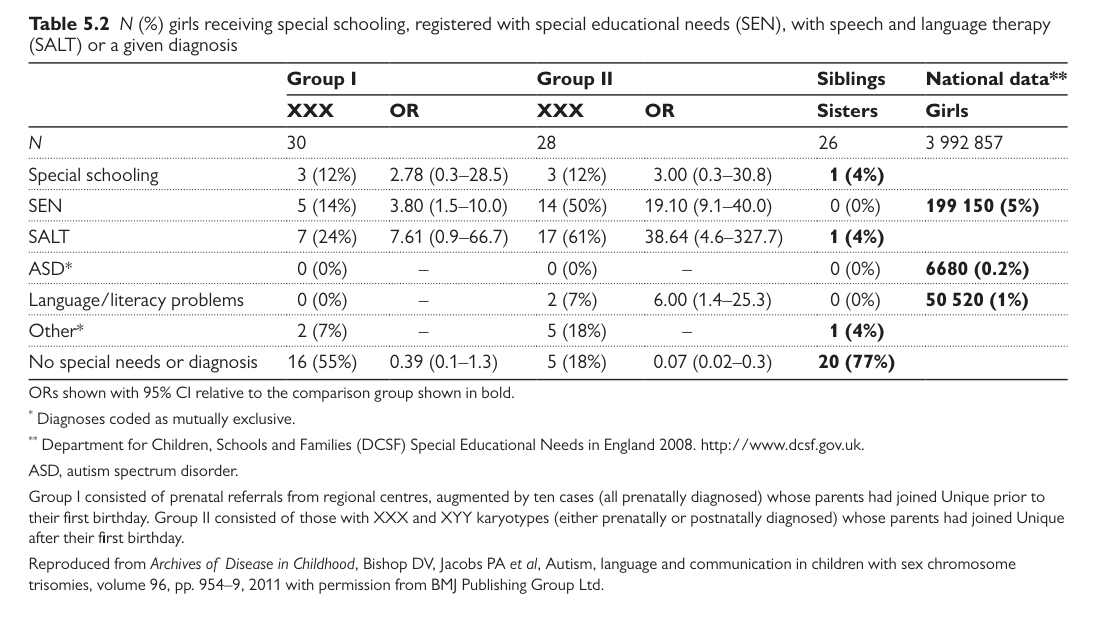
第I组(Group I) 第II组(Group II) 同胞(Siblings) 全国数据(National data)**
XXX OR XXX OR 姐妹(Sisters) 女孩(Girls)
N 30 28 26 3 992 857
特殊学校教育(Special schooling) 3 (12%) 2.78 (0.3–28.5) 3 (12%) 3.00 (0.3–30.8) 1 (4%)
特殊教育需求(SEN) 5 (14%) 3.80 (1.5–10.0) 14 (50%) 19.10 (9.1–40.0) 0 (0%) 199 150 (5%)
言语和语言治疗(SALT) 7 (24%) 7.61 (0.9–66.7) 17 (61%) 38.64 (4.6–327.7) 1 (4%)
孤独症谱系障碍(ASD)* 0 (0%) – 0 (0%) – 0 (0%) 6680 (0.2%)
语言/读写问题(Language/literacy problems) 0 (0%) – 2 (7%) 6.00 (1.4–25.3) 0 (0%) 50 520 (1%)
其他(Other)* 2 (7%) – 5 (18%) – 1 (4%)
无特殊需求或诊断(No special needs or diagnosis) 16 (55%) 0.39 (0.1–1.3) 5 (18%) 0.07 (0.02–0.3) 20 (77%)
OR值所示为相对于粗体对照组的95%可信区间(CI)。
* 各诊断按互斥方式编码。
** 英国儿童、学校与家庭部(Department for Children, Schools and Families, DCSF)《英格兰特殊教育需求2008》(Special Educational Needs in England 2008)。http://www.dcsf.gov.uk。
ASD,孤独症谱系障碍(autism spectrum disorder)。
第I组由来自区域中心的产前转诊病例组成,并补充了10例在1周岁前父母即已加入Unique罕见染色体疾病支持组织的病例(均为产前确诊)。第II组由在1周岁后父母才加入Unique组织的XXX和XYY核型个体(产前或产后确诊)组成。
经BMJ Publishing Group Ltd许可,转载自《Archives of Disease in Childhood》,Bishop DV, Jacobs PA等,Autism, language and communication in children with sex chromosome trisomies,第96卷,第954–9页,2011年。
行为表现(Behavioural) 孤独症的发生风险并未增加(Bishop et al. 2011),但注意缺陷多动障碍(ADHD)/多动的发生风险增加,在Tartaglia等人(2012)的一项家长报告调查中最高风险达50%。一项针对11名XXX女性的美国调查显示,在青春期和成年早期,她们的适应能力较差,相比其XX同胞姐妹承受了更多的压力、工作和人际关系问题。然而,总体而言,她们大多数能够自立且社会功能保持尚佳。性取向正常。
生育力(Fertility) 大多数47,XXX女性具有生育力,并育有染色体正常的婴儿。卵巢功能早衰(premature ovarian failure, POF)的风险可能略有增加。
成年期状况(Adult life) 心血管疾病的发生风险可能轻度增加(Swerdlow et al. 2001)。
临床处置(Clinical approach)
病史采集要点(产后就诊):
- 发育里程碑、言语和语言发育、就学受教育情况。
体格检查要点(产后就诊):
- 身高。
管理(Management) • 告知家长,如果其女儿出现发育、行为或学习困难,应及早就医寻求专业帮助(放宽门槛),因为早期干预可以改善预后。
- Tartaglia等人(2012)建议对产前检出的病例行产前肾脏超声检查(renal USS)。
- 癫痫/异常脑电图(EEG)的发生率略有增高。
- 一般而言,建议仅在“有知情需要(need to know)”的前提下告知其核型,以免该儿童受到差异对待或被他人另眼相看。向儿童告知其47,XXX核型的过程应当是历时多年的渐进过程,家长在此过程中应得到医疗专业人员的支持。有关此主题的全面讨论,请参见Linden等人(2002)的文献。
遗传咨询建议(Genetic advice)
再发风险(Recurrence risk)
47,XXX女孩的父母通常不进行常规核型分析。再发风险很低(<1%)。
后代风险(Offspring risk) 47,XXX女性后代发生染色体异常的风险极低(<1%)。
产前诊断(Prenatal diagnosis) 应向父母及47,XXX女性提供产前诊断(PND),但在极小的再发风险与有创操作相关的妊娠丢失风险之间需要权衡利弊。在有条件的情况下,可提供无创产前检测(non-invasive prenatal testing, NIPT)作为替代选择。
特约顾问:Nicole Tartaglia,发育与行为儿科学专家,科罗拉多大学医学院儿科学副教授,美国科罗拉多儿童医院。
参考文献(References)
Bishop DV, Jacobs PA, Lachlan K, et al. Autism, language and com
munication in children with sex chromosome trisomies. Arch Dis Child 2011; 96: 954–9. Christian SM, Koehn D, Pillay R, MacDougall A, Wilson RD.
Parental decisions following prenatal diagnosis of sex chromosome anomalies, a trend over time. Prenat Diagn 2000; 20: 37–40. Harmon RJ, Bender BG, Linden MG, Robinson A. Transition from
adolescence to early adulthood: adaptation and psychiatric status of women with 47,XXX. J Am Acad Child Adolesc Psychiatry 1998; 37: 286–91. Hook EB. Chromosome abnormalities: prevalence, risks and
recurrence. In: DLH Brock, CH Rodeck, MA Ferguson-Smith (eds.). Prenatal diagnosis and screening, pp. 351–92. Churchill Livingstone, Edinburgh, 1992. Leggett V, Jacobs P, Nation K, Scerif G, Bishop DV. Neurocognitive
outcomes of individuals with a sex chromosome trisomy, XXX, XYY or XXY: a systematic review. Dev Med Child Neurol 2010; 52: 119–29. Linden MG, Bender BG. Fifty-one prenatally diagnosed children
and adolescents with sex chromosome anomalies. Am J Med Genet 2002; 110: 11–18. Linden MG, Bender BG, Robinson A. Intrauterine diagnosis
of sex chromosome aneuploidy. Obstet Gynecol 1996; 87: 468–75. Linden MG, Bender BG, Robinson A. Genetic counselling for sex
chromosome abnormalities. Am J Med Genet 2002; 110: 3–10. Ratcliffe S. Long term outcome in children of sex chromosome
abnormalities. Arch Dis Child 1999; 80: 192–5. Swerdlow AJ, Hermon C, Jacobs PA, et al. Mortality and cancer
incidence in persons with numerical sex chromosome abnormalities: a cohort study. Ann Hum Genet 2001; 65(Pt. 2): 177–88. Tartaglia NR, Avari N, Hutaff-Lee C, Boada R. Attention-deficit
hyperactivity disorder symptoms in children and adolescents with sex chromosome aneuploidy: XXY, XXX, XYY, and XXYY. J Dev Behav Pediatr 2012; 33: 309–18.