Bell等人(2012年)的研究是针对该主题最全面的研究,它是一项基于人群的研究,纳入了任何孕周因胎儿异常终止妊娠、晚期胎儿丢失、死胎以及在12岁以前诊断出的畸形。该研究涵盖了超过400,000例单胎妊娠,其中包括1677例糖尿病孕妇。在该项研究中,糖尿病母亲婴儿(infants of diabetic mothers, IDMs)的非染色体重大先天畸形(major congenital malformations)发生率为7%(相对危险度为4)。畸形风险与围受孕期糖化血红蛋白(HbA1c)水平存在明确的关联;围受孕期HbA1c为10%时的畸形风险为1/9,而围受孕期HbA1c为6.1%时的风险为1/33。当HbA1c高于6.3%(45 mmol/mol)时,先天畸形的风险随着HbA1c的升高呈线性增加,HbA1c每升高1%(11 mmol/mol),风险增加近30%。其他大型研究和荟萃分析得出了相似的结论。1型糖尿病(T1D)与2型糖尿病(T2D)患者后代的先天畸形发生率之间无显著差异。畸形风险仅限于受孕时即患有糖尿病的患者,妊娠期糖尿病(gestational diabetes)患者中未见该风险。
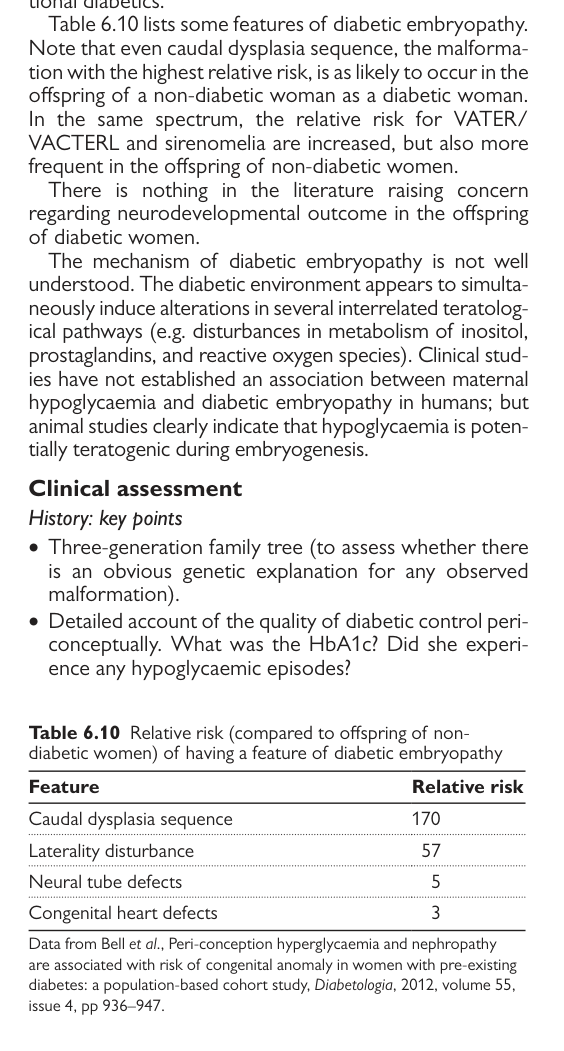
表6.10列出了糖尿病胚胎病的部分特征。需要注意的是,即使是相对危险度最高的畸形——尾侧发育不良序列征(Caudal dysplasia sequence),其在非糖尿病女性后代中的发生可能性也与糖尿病女性后代相当。在同一疾病谱中,VATER/VACTERL联合征以及并腿畸形(Sirenomelia)的相对危险度虽有所增加,但在非糖尿病女性的后代中发生频率实际上也更高。
目前文献中尚无引起对糖尿病女性后代神经发育结局担忧的报道。
糖尿病胚胎病的发病机制尚未完全阐明。糖尿病微环境似乎同时诱导了数条相互关联的致畸通路发生改变(例如肌醇代谢紊乱、前列腺素以及活性氧自由基的改变)。在人类中,临床研究尚未确立母体低血糖(Hypoglycaemia)与糖尿病胚胎病之间的明确关联;但动物实验明确表明,胚胎发生期的低血糖具有潜在的致畸性。
临床评估
病史:要点
- 三代家系图(以评估所观察到的任何畸形是否存在明确的遗传学解释)。
- 围受孕期糖尿病控制质量的详细记录。当时的HbA1c是多少?她是否经历过任何低血糖发作?
特征 相对危险度
尾侧发育不良序列征(Caudal dysplasia sequence) 170
偏侧性异常(Laterality disturbance) 57
神经管缺陷(Neural tube defects) 5
先天性心脏病(Congenital heart defects) 3
数据引自 Bell 等人,Peri-conception hyperglycaemia and nephropathy are associated with risk of congenital anomaly in women with pre-existing diabetes: a population-based cohort study, Diabetologia, 2012, 第 55 卷, 第 4 期, 第 936–947 页。
- 简要询问其他可能的致畸暴露史,如药物、感染、酒精等。
- 若患儿为活产,详细询问围产期病史、出生体重及生长参数。
体格检查:要点
- 若发现胎儿异常,对父母进行体格检查,例如若胎儿/儿童存在肢体缺陷,检查父母的双手/双足;若为心脏缺陷,同样进行相应检查。
特殊检查
- 母体血清神经管缺陷(NTD)筛查(实验室必须获知母体患有糖尿病,因为甲胎蛋白 [AFP] 的正常参考值需要进行相应调整)。
- 详细的胎儿畸形超声检查(fetal anomaly USS)。Wong等人(2002年)发现,糖尿病女性胎儿异常的检出率(30%)低于非糖尿病女性(73%),其主要原因在于超声图像质量欠佳(母体肥胖是主要影响因素 [Best等人,2012年])。
- 糖化血红蛋白(HbA1c,评估过去6–8周内的血糖控制水平)。在一组病例报告中(Wong等人,2002年),围受孕期HbA1c >9%与重大异常的高发生率(14.3%)密切相关。
- 若存在多发畸形,进行基因组微阵列芯片分析(Genomic array)。
- 考虑行胎儿/出生后超声心动图检查(echo)。
后续妊娠的管理 应在受孕前遵循NICE指南(http://www.nice.org.uk/)优化糖尿病控制。所有糖尿病女性均需由具备母胎医学专业特长的产科专科医生进行专业化管理。
专业审校顾问:Judith Goodship,英国纽卡斯尔大学人类遗传学研究所前医学遗传学教授。
参考文献
Balsells M, Garcia-Patterson A, Gich I, Corcoy R. Maternal and
fetal outcome in women with type 2 versus type 1 diabetes mellitus: a systematic review and metaanalysis. J Clin Endocrinol Metab 2009, 94: 4284–91. Banhidy F, Acs N, Puhó EH, Czeizel AE. Congenital abnormalities
in the offspring of pregnant women with type 1, type 2 and gestational diabetes mellitus: a population-based case-control study. Congenit Anom (Kyoto) 2010; 50:115–21. Bell R, Glinianaia SV, Tennant PW, Bilous RW, Rankin J. Peri-con
ception hyperglycaemia and nephropathy are associated with risk of congenital anomaly in women with pre-existing diabetes: a population-based cohort study. Diabetologia 2012; 55: 936–47. Best KE, Tennant PW, Bell R, Rankin J. Impact of maternal body
mass index on the antenatal detection of congenital anomalies. BJOG 2012; 119: 1503–11. Corrigan N, Brazil DP, McAuliffe F. Fetal cardiac effects of mater
nal hyperglycemia during pregnancy. Birth Defects Res A Clin Mol Teratol 2009; 85: 523–30. Eriksson UJ, Borg LA, Cederberg J, et al. Pathogenesis of diabe
tes-induced congenital malformations. Ups J Med Sci 2000; 105: 53–84. Garne E, Loane M, Dolk H, et al. Spectrum of congenital anoma
lies in pregnancies with pregestational diabetes. Birth Defects Res A Clin Mol Teratol 2012; 94: 134–40. Inkster ME, Fahey TP, Donnan PT, Leese GP, Mires GJ, Murphy
DJ. Poor glycated haemoglobin control and adverse pregnancy outcomes in type 1 and type 2 diabetes mellitus: systematic
review of observational studies. BMC Pregnancy Childbirth 2006; 6: 30. Jensen DM, Damm P, Moelsted-Pedersen L, et al. Outcomes in
type 1 diabetic pregnancies: a nationwide, population-based study. Diabetes Care 2004; 27: 2819–23. Mills JL, Simpson JL, Driscoll SG, et al. Incidence of spontaneous
abortion among normal women and insulin-dependent diabetic
women whose pregnancies were identified within 21 days of conception. N Engl J Med 1988; 319: 1617–23. Schwartz R, Teramo KA. Effects of diabetic pregnancy on the
fetus and newborn. Semin Perinatol 2000; 24: 120–35. Wong SF, Chan FY, Cincotta RB, Oats JJ, McIntyre HD. Routine
ultrasound screening in diabetic pregnancies. Ultrasound Obstet Gynecol 2002; 19: 171–6.